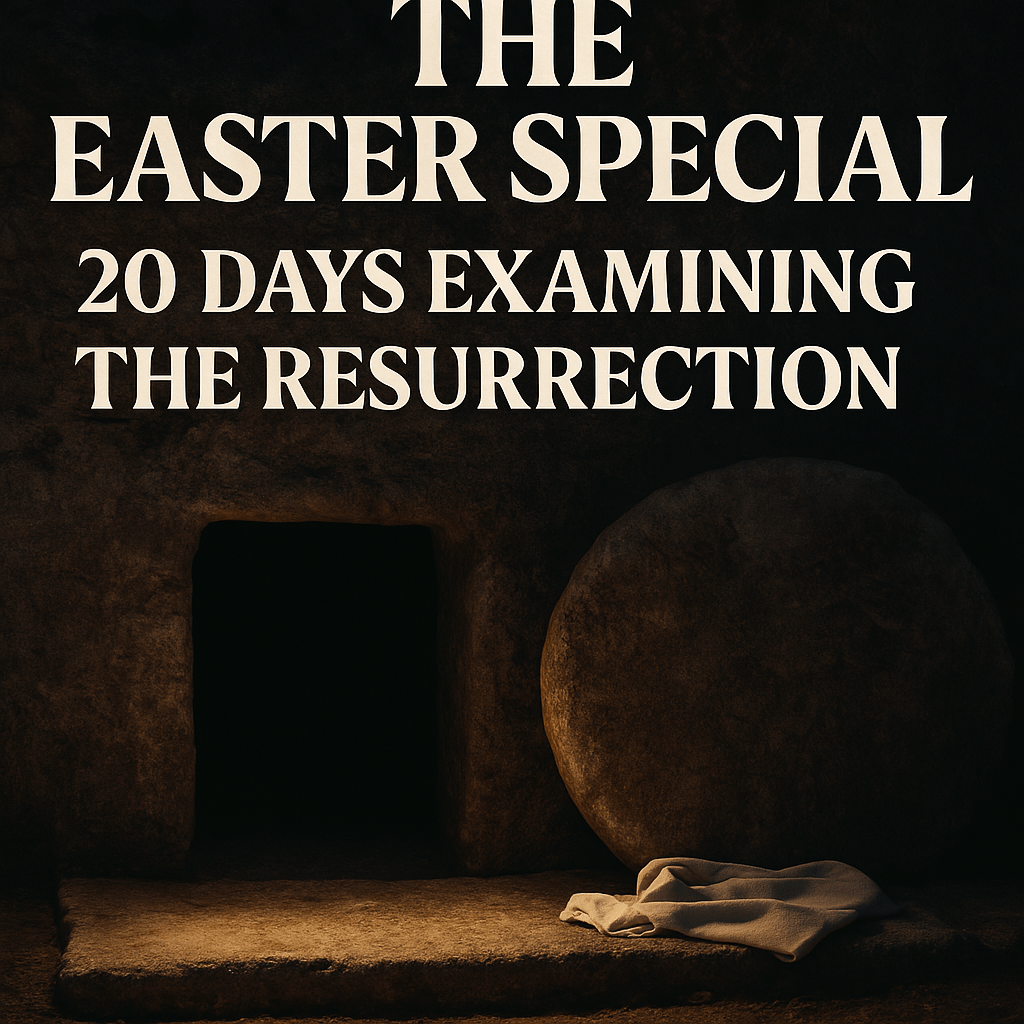
✨ Welcome to Our Easter Special
From April 1 through April 20, The God Question will explore what is arguably the most important claim in all of Christianity: Did Jesus of Nazareth actually rise from the dead?
Each post in this series critically examines one aspect of the Easter story—historically, psychologically, theologically, and scientifically.
📌 What We’re Asking:
- What does the evidence really say?
- How reliable are the Gospels?
- Can resurrection claims survive honest scrutiny?
We invite you to walk with us—step by step—as we explore these questions with humility, curiosity, and a commitment to truth.
🗓️ Day 1: Was Jesus Really Buried in a Tomb?
The traditional Easter story begins with Jesus’s burial in a rich man’s tomb, owned by Joseph of Arimathea. But how solid is this claim? Can we trust it? Or is the story already evolving before the resurrection even begins?
Let’s examine the evidence—and the problems—with the burial narrative.
🧱 The Traditional Claim
- Jesus was crucified.
- A respected council member, Joseph of Arimathea, took his body.
- Jesus was placed in a new tomb carved from rock.
- The tomb was sealed and guarded.
- On the third day, the tomb was found empty.
This version comes primarily from the Synoptic Gospels (Mark, Matthew, and Luke), with added details in John.
🚩 What’s the Problem?
- Burial After Crucifixion Wasn’t the Norm: Crucified criminals in the Roman Empire were usually left on the cross or thrown into mass graves. Giving Jesus a private tomb was not only unusual—it would have required an exception from Roman policy.
- Joseph of Arimathea Is an Unknown Figure: We know nothing else about Joseph. He appears suddenly in the story, plays a major role, and then disappears. Why would a “respected council member” (Mark 15:43) risk his position to honor a crucified rebel?
- Mark May Have Invented the Tomb Story: Many scholars believe Mark—the earliest Gospel—created the “empty tomb” motif to give the resurrection a physical location. Earlier Christian writings, including Paul’s letters, mention Jesus’s death and resurrection but say nothing about a tomb.
- Paul Doesn’t Mention a Tomb: In 1 Corinthians 15:3–8, Paul writes what many believe is the earliest Christian creed: “Christ died for our sins… he was buried… he was raised on the third day…” Yet Paul never references a tomb—not even once. If the empty tomb were known, why would Paul leave it out?
🔍 Applying The God Question’s Core Philosophy
1. Is the claim based on evidence or tradition? It’s rooted in Gospel tradition, not external evidence. No Roman, Jewish, or archaeological sources confirm the burial.
2. Are alternative explanations considered? Christian apologists often ignore Roman burial practices. A simpler explanation: Jesus’s body was discarded—like most crucified criminals.
3. Is the claim falsifiable? No. The tomb’s location is unknown. There is no way to verify its existence or emptiness.
4. Does the explanation raise more questions than it answers? Yes. Why introduce an unknown character (Joseph)? Why such detailed burial rituals for a condemned man? Why the silence in Paul’s letters?
🧭 Final Thought
The tomb story may not be the historical beginning of Easter. It may be the literary beginning—crafted by early writers to give form to a spiritual belief.
If the burial claim itself is uncertain, what does that mean for the rest of the resurrection narrative?
Let’s keep asking.
📺 For Further Exploration
Video: The BURIAL of Jesus–The Overlooked Key for Understanding How Resurrection Faith Was Born!
A biblical historian explains why Roman burial practices—and Paul’s silence—cast serious doubt on the Gospel tomb story.
📅 Note: After we wrap up our 20-Day Easter Special on April 20, we’ll return to our regular schedule of posting three times a week:
- Tuesdays & Fridays – our structured explorations through all 11 blog categories
- Sundays – our Sunday Special Feature, where we critically respond to real-world religious claims in real time
We hope you’ll stay with us as we continue asking bold questions and applying reason to faith.

 God or Delusion?