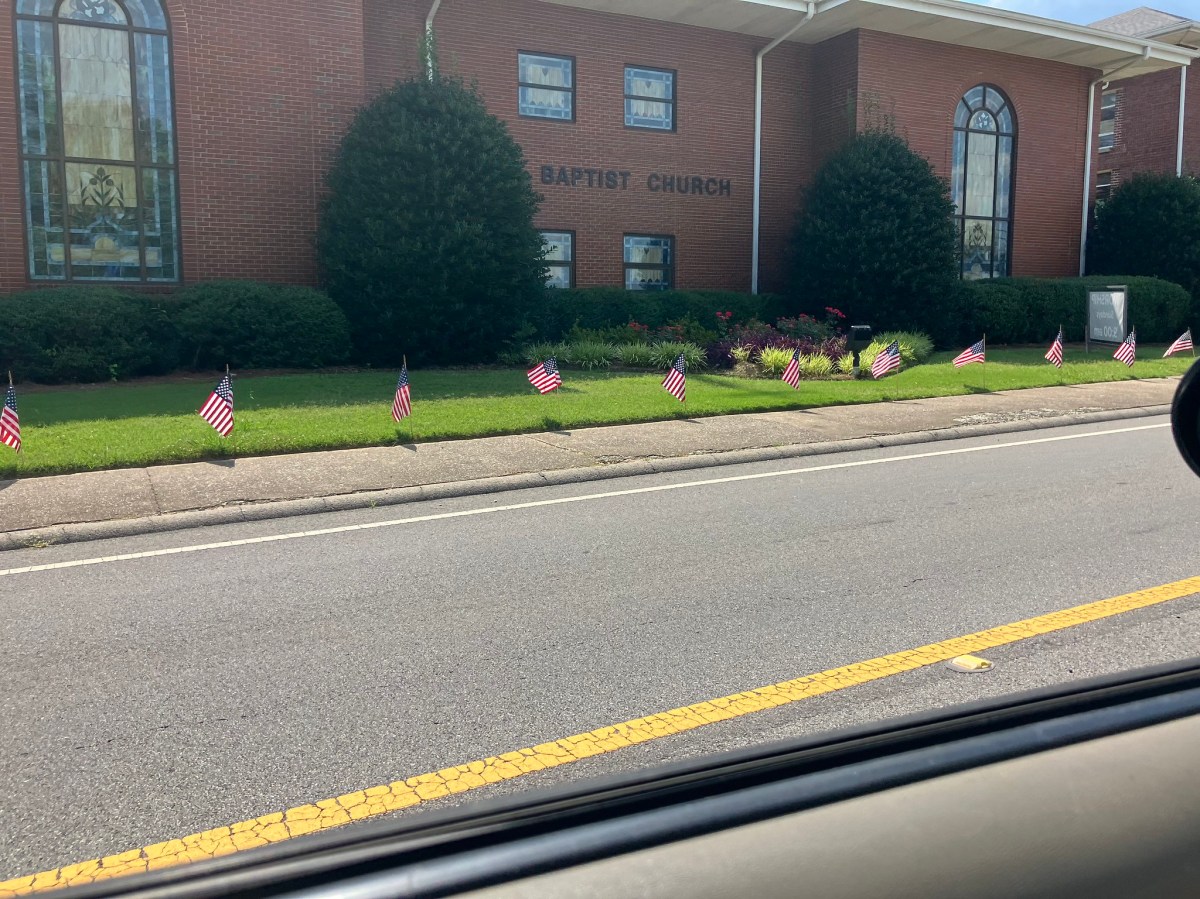
Yesterday, July 4th, I rode by First Baptist Church of Boaz and saw something that left me uneasy. Along the sidewalk, stretching across their front lawn, were dozens and dozens of tiny U.S. flags, each spaced out in a perfect, respectful row. It was clearly a tribute to America’s Independence Day — a show of patriotism. But in front of a church?
It struck me as a troubling symbol of how deeply certain forms of Christianity — especially Southern Baptist Fundamentalism — have tangled themselves up with nationalistic fervor. On the surface, maybe it looks harmless: honoring the nation, remembering veterans, celebrating the Fourth of July. But to me, those rows of flags waving proudly outside a place that claims to follow Jesus reveal something far more dangerous.
Let me be transparent. I do not believe Jesus was the supernatural Son of God described by Christian creeds. I do not believe He was divine, or that any divine being guided Him. And to be honest, I’m not even completely confident that Jesus the human, as described in the Gospels, actually existed. There may have been a historical teacher whose memory inspired the stories, but whether such a person truly lived is, for me, still an open question.
Still, if we work from the premise that someone named Jesus — a Galilean teacher — stood up against empire and religious hypocrisy, then what the Bible preserves about Him should at least partially represent a message that transcended nationalism. He proclaimed a kingdom “not of this world,” a movement that refused to be captured by flags or patriotic loyalty.
And that is exactly why this flag-lined church lawn is so disorienting. It seems to me that any honest reading of the New Testament would find a Jesus who taught about a kingdom beyond empires, militaries, or national symbols.
So why, then, do so many Southern Baptist churches embrace American flags as if they were sacred objects? Why conflate “God” with “country” so uncritically?
In my view, it comes down to comfort, nostalgia, and a need for belonging. If the church can wrap the cross in the stars and stripes, it doesn’t have to confront what Jesus (real or not) is said to have taught. It can claim to follow a crucified peasant from Galilee while at the same time feeling like it is on the winning team of history. It can baptize its political identity in religious language, and that feels safe.
But that is not Christianity, at least not in any sense that takes even the idea of Jesus seriously. That is civil religion — a convenient way to merge faith with patriotic sentiment, while ignoring any challenge to empire, power, and violence.
To me, those flags in front of First Baptist Boaz reveal what has gone wrong with so much American religion. The message is subtle but unmistakable: “You can have Jesus, but only if you pledge allegiance to this flag first.”
If there was ever a reason to question the fundamentalist version of Christianity, to pull back the layers and ask what really matters, this is it. I hope more people will pause, see those flags, and realize that maybe — just maybe — Jesus (if He even lived) would have walked right past them, still preaching a kingdom that had nothing to do with them at all.

 God or Delusion?