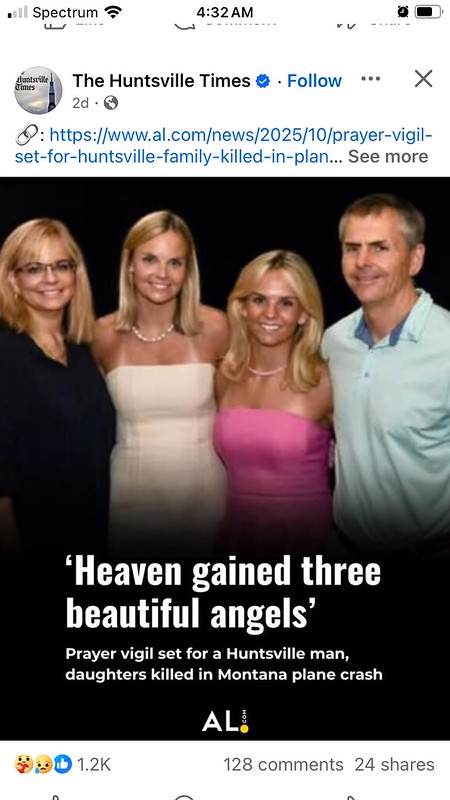
“Heaven Gained Three Angels”: When Journalism Preaches Instead of Reporting

Screenshot

How a Newspaper Headline Became a Sermon—And What That Says About Our Culture

I saw the headline and had to look twice.

“Heaven gained three beautiful angels.”

This wasn’t posted by a church or a grieving relative. It came from The Huntsville Times, a professional media outlet, as it promoted a story from AL.com about a tragic plane crash in Montana that killed a father and his two daughters.

And with that headline, journalism stopped being journalism.


✝️ Not Reporting—Preaching

It’s one thing to quote a grieving mother who says, “They’re with Jesus now.” That’s personal. It’s human. It’s part of the story.

But when the headline declares that heaven gained three angels, the paper isn’t quoting—it’s asserting. It’s adopting a specific theological worldview and presenting it as if it were fact.

Imagine the outcry if a headline had said:

“Three lives lost. No god answered.”

That would be labeled offensive. Cold. Atheistic propaganda.

But when religious language is used—especially Christian language—it somehow slides past our filters. It feels “normal.” It feels “comforting.”

And that’s precisely the problem.


🧠 The Comfort Trap

Why did AL.com choose that headline? Because it comforts. Because it fits the mold. Because it avoids the unbearable reality of what happened:

  • A young, vibrant flight instructor died.
  • Her sister, still so full of life, died with her.
  • Their father, a man who raised and flew with them, died too.
  • One woman—their mother—is left behind with a silence no prayer vigil can fill.

Saying they became angels in heaven is not truth. It’s a story we tell because the real story hurts too much. But pain doesn’t justify abandoning truth. And journalism, of all places, should not be where truth goes to die.


🔍 But What’s the Evidence?

Let’s ask the obvious question:

What evidence is there that these three are now angels in heaven?

The answer is none.

No data. No observation. No credible, testable claim. Just inherited beliefs and cultural rituals. Repeated so often that we confuse them for reality.

If we truly care about honoring the dead, we should honor the truth of their lives—not overwrite it with fantasies.


😔 What This Headline Reveals

This headline exposes something deeper about our culture:

  • We are terrified of death.
  • We’d rather believe in invisible comfort than visible suffering.
  • We confuse sentiment with truth—and elevate the former over the latter.

Journalism should not reinforce that confusion. It should challenge it.

Because every time a newspaper becomes a pulpit, the public loses an opportunity to think. To reflect. To face what’s real.

And in a society addicted to soft lies, we need more clarity—not more comforting illusions.


🧾 Final Thought

I don’t know what happens when we die. No one does.

But I do know this: it cheapens our grief when we skip past the sorrow and reach for a heaven we can’t see, a god we can’t prove, and wings that were never there.

If The Huntsville Times wants to share hope, let it do so through human compassion, through truth, and through the incredible life stories of those we’ve lost.

Not through preaching.
Not through platitudes.
And not by pretending.
When a 15-Year-Old Dies: Grief, Faith, and the Questions We Must Still Ask

“Jesus Saves.”

That was the message stitched onto the back of Branson Peppers’ football uniform.

He was 15.

A sophomore at Sardis High School.

An athlete, a teammate, a friend.

Gone in an instant—killed in a head-on crash while riding a four-wheeler less than half a mile from my home.

And now, as photos and tributes flood social media, I feel both heartbreak and unease. Branson was clearly loved by many. His death has sent waves of sorrow through our small North Alabama community. But it’s what people are saying in response—what they feel they must say—that troubles me most.

“He’s with Jesus now.”

“God has a plan.”

“We know he’s in heaven.”

These words come quickly. Automatically. But are they true?


The Comfort of Certainty

In times of tragedy, religion often steps in with ready-made answers. It’s natural. We want to believe there’s some larger meaning. Some unseen rescue. Some divine promise that death is not the end.

So we say things like “Jesus saves.” We share hashtags like #Forever8 and #JesusSaves. We claim, with absolute conviction, that a 15-year-old who died in an ATV accident is now safe in Heaven, embraced by God.

I understand why people say it. I really do.

But here’s the honest, human truth:

That conviction is based on belief, not evidence.

And belief, no matter how deeply felt, does not make something real.


What Jesus Didn’t Save

Branson believed. His family believed.

His helmet, his backpack, his game-day gear—it all proclaimed the message: “Jesus Saves.”

But Jesus didn’t save him.

Not from the corner he rounded too fast.

Not from the truck he couldn’t see.

Not from the head-on impact that ended his life.

People will say, “He did save him—eternally.”

But that response quietly shifts the meaning of “save” from something physical and tangible to something unverifiable.

It also avoids the question we must ask if we’re being honest:

Why didn’t Jesus save him now, here, in this life?


What We Know—and What We Don’t

Here’s what we know for certain:

  • Branson Peppers died in a tragic accident.
  • His brain ceased functioning.
  • His heart stopped.
  • His consciousness, everything he was, is no longer here.

Beyond that—everything is speculation.

There is no verifiable evidence that Branson went to heaven. No evidence that he still exists in another realm. No sign that he’s watching over us. These are ideas people hope are true. But hope, however comforting, is not truth.

That doesn’t make the grief any less real.

It just makes the truth harder to face—and maybe more important than ever.


The God Question in the Midst of Tragedy

Here’s what I believe now:

Branson mattered. He lived, and he loved, and he was loved.

That is sacred. That is enough.

Not because a god said so—but because we say so. Because we feel it.

We honor his life by telling the truth:

He died too young.

It wasn’t part of some divine plan.

And no amount of belief will bring him back.

That truth is brutal. But it’s also freeing.

Because if we stop pretending that there’s a cosmic rescue plan, we might finally begin to see just how precious—and fragile—this one life really is.


To Those Who Still Believe

If you find comfort in your faith, I don’t fault you.

We all reach for meaning when tragedy strikes.

But I ask you gently: Is the comfort you feel built on something true?

Or is it built on something you’ve been told your whole life to believe?

When we say, “Jesus saves,” but he doesn’t save a 15-year-old from death—don’t we owe it to ourselves, and to Branson, to ask what that really means?

And if we find that it means nothing at all…

Maybe we can begin to build a different kind of hope.

One rooted not in myth, but in the fragile, beautiful truth of being here now—together.


Final Thoughts

To Branson’s family, friends, and teammates:

I offer my deepest sympathy.

I do not believe in an afterlife, but I do believe in love.

And I believe Branson’s life mattered—not because of where he is now, but because of what he meant while he was here.

His absence is devastating.

But let us not pretend it was prevented.

Let us honor him, not with certainty, but with honesty.

Because the truth, even in grief, is sacred.

Where Was God?

Reflections on the July 4th Texas Flood and the Questions Faith Refuses to Ask

On July 4, 2025—Independence Day—freedom was replaced with devastation in parts of Texas. As torrential rains swept through Hill Country, homes were lost, families shattered, and lives stolen. Among the hardest-hit was Camp Mystic, a cherished place for many girls and their families. In the days that followed, social media filled with grief, prayer requests, and calls for healing. One such post came from counselor Sissy Goff, who, with deep sincerity, offered a webinar for parents and caregivers: Helping Kids Process Grief: The Tragedy at Camp Mystic.

But as we sit with the pain, we must also sit with the questions. Real ones.

Where was God?

This question isn’t meant to provoke—it’s meant to clarify. It’s what The God Question was created to ask. Because when tragedy strikes, we don’t just grieve—we reach for explanations. And in Southern Baptist churches like those across Texas, the answers tend to come quickly:

  • “God is in control.”
  • “His ways are higher than ours.”
  • “This is all part of His plan.”
  • “We may not understand, but we must trust.”

But let’s pause. Let’s not rush past the pain with platitudes. Let’s look, instead, with clarity, compassion, and courage.


The God Question’s Core Philosophy

We approach these questions by asking:

If this happened in a godless world—would we expect it? If this happened in a God-run world—what kind of God would it suggest?And what does this event actually demonstrate in the real world, without belief-based spin?

Here’s what we see.

  • The flood was not stopped.
  • Innocent lives were lost.
  • Prayers did not prevent the tragedy.
  • No divine rescue came for the children trapped by rising waters.

The event unfolded exactly as it would in a natural world governed by climate, geography, and chance. No intervention. No supernatural mercy. No evidence of a higher power altering outcomes.


What Does Faith Say?

Southern Baptist Fundamentalism typically reframes tragedies like this in a few predictable ways:

“This world is fallen.” Sin, we’re told, broke creation. Suffering is the consequence. But how just is a system where children drown because a distant ancestor ate forbidden fruit? Would we call that love—or abuse?

“God allows suffering to build character or teach others.” Let’s be honest: What kind of being teaches lessons through drowned girls and grieving parents? Would we accept this logic from any earthly leader?

“We’ll understand in heaven.” A promise of future clarity cannot excuse present injustice. If the answers only come after death, they cannot be tested. They cannot be known. And they cannot justify what we see here and now.

“God was with them in the water.” This poetic sentiment avoids the central issue: Why didn’t He act? Presence without protection is not love—it’s negligence.


What the Flood Reveals

The July 4th flood didn’t just expose environmental vulnerabilities. It exposed theological ones. It revealed that nature operates independently of prayer. That tragedy comes to the faithful and the faithless alike. That divine intervention is indistinguishable from absence.

If a God exists, He did not act. If He did not act, then what are we worshipping?


Toward a More Honest Compassion

This does not mean we must become cold or cynical. Quite the opposite. In a godless world, we become the ones who must act. We become the comforters, the responders, the rebuilders. Not because God told us to. But because we care.

Real compassion begins when we stop outsourcing morality to invisible beings and start living it ourselves.


Closing Reflection

The children and families of Camp Mystic deserved better—not just from the weather, but from our theology. As we grieve, let’s not hide from the hardest question of all:

Where was God?

If the answer is silence—then let’s finally listen to it.

A Response to Pastor Brown’s Sermon at First Baptist Church of Boaz (July 6, 2025)

Yesterday, Pastor Brown of First Baptist Church of Boaz delivered a sermon that, like so many within Southern Baptist Fundamentalism, framed the Christian message in strong terms of human depravity, divine wrath, and absolute submission. As someone who embraces The God Question’s philosophy — a commitment to reason, moral clarity, and honest evidence — I want to explore how this sermon illustrates the deeper challenges of evangelical Christianity.

My goal is not to belittle Pastor Brown personally, but to test the ideas he presented. Because if we care about truth, then even the most deeply cherished beliefs must be held up to examination.


1. The Framing of Human Nature as Fundamentally Worthless

Pastor Brown repeatedly characterized human beings as:

  • “helpless”
  • “slaves to sin”
  • “incapable of any good”
  • “terrible”
  • “born in rebellion”

He even suggested that God expects us to fail.

This is an extraordinarily harsh anthropology — a theology of cosmic self-loathing. It depicts people as worthless unless they submit entirely to a divine authority.

Yet from a reasoned, human-centered perspective, human beings are far more than this. We are capable of empathy, courage, moral growth, and solidarity — no supernatural grace required. Civilizations have built ethical systems for thousands of years without the threat of eternal punishment.

The God Question would argue this rhetoric of worthlessness is a tool for manipulation, breaking a person down so they can be rebuilt under the control of a spiritual hierarchy.


2. Prayer and “God’s Will” in the Face of Suffering

At the start, Pastor Brown offered prayer for victims of flooding in Texas, asking God to comfort them and protect first responders.

But this raises the problem familiar to many:

  • If God is loving and all-powerful, why permit the tragedy to happen?
  • If God designed the laws of nature, why allow a world where rivers suddenly rise and kill children?

Blaming these disasters on “a broken world in rebellion” makes no sense. Rivers do not rebel. Storms do not sin. Nature is nature.

If believers want to say God could intervene at any moment, but usually chooses not to, then we must ask why such a God is worthy of worship. That is the honest question Pastor Brown’s theology tries to sidestep.


3. Substitutionary Atonement and Inherited Guilt

A major theme of the sermon was how Christ’s righteousness is “imputed” to believers because no human can meet God’s standard. According to Pastor Brown, all people are doomed to fail unless they accept this divine swap: Jesus’s perfection for their cosmic guilt.

But think carefully about this:

  • Why should one person’s execution 2,000 years ago erase my moral responsibility?
  • Why would a wise, just God require blood sacrifice instead of simply forgiving?
  • Why declare a newborn “guilty” for existing?

This is scapegoating, not justice. The notion that you are guilty simply for being human, and require a blood sacrifice to be forgiven, violates any reasonable idea of moral fairness.


4. Psychological Manipulation and Fear

The entire sermon revolved around a classic spiritual bait-and-switch:

  1. First, break the hearer down with reminders of their failures.
  2. Second, insist there is no hope except total surrender to Jesus.

This is emotional and mental manipulation, pure and simple. It is designed to create despair — and then offer a rescue. That is how authoritarian systems control people: undermine their confidence and then sell them the only “cure.”

At The God Question, we believe that a worldview requiring fear, guilt, and shame to sustain itself is a worldview that deserves deep skepticism.


5. Intellectual Honesty About Jesus

Pastor Brown assumed as fact that Jesus existed, was divine, and rose from the dead. He did not even mention the possibility that:

  • Jesus may never have existed as a historical figure
  • The stories of miracles and resurrection are legendary or invented

These are legitimate questions, backed by serious scholarship, and yet they were left completely unexamined.

If Christianity is true, it should withstand honest inquiry. Instead, Pastor Brown treated its core claims as beyond question. That is an intellectual failure.


6. The Moral Framework: Obedience as Love

Finally, Pastor Brown equated obedience with love:

“If you do not obey, you don’t love.”

That is a disturbing equation. Love should be free, voluntary, rooted in mutual respect. Obedience, on the other hand, is about power and hierarchy.

Tying love to obedience is a strategy for control. It trains people to submit, and to call that submission “love,” which blurs the line between healthy relationships and spiritual coercion.

The God Question holds that real love is about honesty, growth, and chosen commitment — not servile obedience to an authority figure.


Conclusion

Pastor Brown’s sermon was heartfelt, no doubt sincere, and in line with long Baptist tradition. But it stands on a theology that demands human debasement, fear, and unquestioning obedience — all enforced by threats of condemnation.

At The God Question, our invitation is simple: question it. Don’t take these claims on faith alone. Investigate them. Measure them. Test them. Demand moral coherence and intellectual honesty.

If there is a God who gave you a mind, wouldn’t that God want you to use it?

How to Spot Logical Fallacies in Religious Debates

When someone makes a bold religious claim—especially one involving supernatural events, eternal rewards or punishments, or divine authority—it can be difficult to know how to respond. The language is often emotional. The audience is expected to accept things on faith. And the pressure to conform can be overwhelming.

But there is one powerful tool we can all learn to use: logic.

If you want to evaluate religious claims with a clear mind, start by learning how to spot logical fallacies—errors in reasoning that can mislead even the most intelligent among us. Today, we’ll explore some of the most common fallacies found in religious debates, and how to recognize them in action.


🚩 1. Appeal to Authority

Fallacy: “The Bible says it, so it must be true.”
Why it fails: Just because a source claims authority doesn’t mean it’s reliable. All ancient texts—including religious ones—must be evaluated on historical, logical, and evidentiary grounds. The claim that a book is divine cannot be the evidence for its divinity.

🔎 Ask this instead: What objective evidence shows this authority is trustworthy?


🚩 2. Circular Reasoning

Fallacy: “Jesus must be God because the Bible says so, and the Bible must be true because Jesus is God.”
Why it fails: The argument relies on its own conclusion to prove itself—offering no independent evidence.

🔎 Ask this instead: Is there any way to test this claim without assuming it’s already true?


🚩 3. Appeal to Consequences

Fallacy: “If you don’t believe, you’ll go to Hell.”
Why it fails: Whether a belief has good or bad consequences has nothing to do with whether it’s true. Fear of punishment or hope of reward is a tool of emotional coercion—not rational argument.

🔎 Ask this instead: What does the actual evidence say about the claim, regardless of how it makes me feel?


🚩 4. False Dichotomy

Fallacy: “Either Jesus is Lord, or he was a liar or lunatic.”
Why it fails: This trilemma (popularized by C.S. Lewis) ignores many other possibilities—such as legend, exaggeration, or error in transmission over centuries.

🔎 Ask this instead: Are there more than two (or three) explanations for the evidence?


🚩 5. Burden of Proof Reversal

Fallacy: “You can’t prove God doesn’t exist, so He must.”
Why it fails: The person making the claim has the responsibility to prove it. If I claim there’s an invisible dragon in my garage, it’s not up to you to disprove it—it’s up to me to demonstrate it.

🔎 Ask this instead: What direct, falsifiable evidence supports this claim?


🧭 The Bottom Line

When religious beliefs are discussed, the bar for truth often gets lowered in the name of faith. But beliefs that shape lives, relationships, and public policy deserve just as much scrutiny as any other claim about the world.

By learning to spot logical fallacies, you gain clarity—and give yourself permission to ask better questions.

Looking Back, Moving Forward: The Journey Into Phase 2

For the past few weeks, we’ve laid the foundation for something bigger—an honest, critical, and open exploration of faith, reason, and the questions that matter.

We’ve taken time to define what this space is about: a place where we don’t settle for easy answers, where we dare to ask why we believe what we believe, and where faith and reason meet at a crossroads.

Now, it’s time to take the next step.


Where We’ve Been

Since launching, we’ve tackled some key themes that shape the discussions ahead:

🔹 The Importance of Questioning Belief – Why critical thinking isn’t an enemy of faith but a necessary part of understanding it.

🔹 Theological Fear vs. Intellectual Honesty – How fear-based teachings can discourage honest inquiry and how to move past them.

🔹 Faith, Doubt, and the Role of Reason – Examining whether belief and reason are at odds or if they can coexist.

🔹 Sunday Special Features – Deep dives into theological issues, exploring stories, doctrines, and perspectives that challenge conventional wisdom.

These discussions have set the stage for something more structured and in-depth.


Where We’re Going: Phase 2 Begins

Starting Tuesday, we’re shifting into Phase 2: Cycling Through All 11 Categories in Order (March 25 – April 29).

What does this mean? Instead of posting in a free-form way, we’ll be systematically working through each of the core themes that define this journey.

This will ensure that every major topic gets the depth, analysis, and conversation it deserves.

We’ll take our time. We’ll ask hard questions. And, most importantly, we’ll keep things clear, structured, and engaging.


What to Expect

💡 Each post (Tuesday and Friday), we’ll focus on a different major category—giving each topic space to be fully explored.

📖 Some posts will analyze scripture, history, and doctrine. Others will examine philosophy, science, and personal experience.

❓ We’ll raise questions without demanding specific answers—because thinking critically matters more than memorizing dogma.


Join the Conversation

This blog isn’t just about presenting ideas—it’s about engaging with them.

🔹 What topics are you most excited for?

🔹 What big questions have been on your mind?

🔹 What would you like to see explored in more depth?

Drop your thoughts in the comments or reach out directly. Your insights, questions, and challenges make these discussions richer.

Phase 2 begins Tuesday. Let’s keep the conversation going. 🚀

The Psychology of “Answered” Prayers

Welcome back to The God Question.

In a previous post, Does Prayer Really Work?, we examined the scientific evidence behind prayer. Studies show that prayer has no measurable supernatural effects—people who are prayed for don’t heal faster, win lotteries, or avoid disasters at a higher rate than those who aren’t.

But if prayer doesn’t actually change reality, why do so many believers feel certain that their prayers are answered?

This post shifts the focus from scientific studies to psychology, exploring the mental habits and cognitive biases that make people believe prayer works—when, in reality, it doesn’t.


For believers, prayer is often seen as a direct line to God—a way to ask for help, guidance, or healing. Many claim to have personally experienced answered prayers, reinforcing their faith and deepening their belief in divine intervention.

But skeptics ask: Are these prayers truly being answered, or is something else at play?

When we examine the psychology behind prayer, we find that confirmation bias, selective memory, and emotional reinforcement play significant roles in why people believe their prayers are answered. In reality, answered prayers may not be as miraculous as they seem.


1️⃣ Why Do People Believe Prayer Works?

Most religious traditions teach that prayer has real power—that God listens and responds. When someone prays and feels that their request has been fulfilled, it reinforces the idea that God intervened.

📌 Common Examples of “Answered” Prayers:
✔ Recovering from an illness after praying for healing.
✔ Finding a job after asking God for help.
✔ Surviving a dangerous situation after pleading for protection.

These experiences feel deeply personal and are often cited as proof that prayer is effective. But are they truly supernatural events, or do they have psychological explanations?


2️⃣ The Role of Confirmation Bias

Confirmation bias is the tendency to notice, remember, and interpret information in a way that supports our existing beliefs.

🔹 When people pray, they are more likely to notice events that align with their prayers and ignore those that don’t.
🔹 If something good happens, it’s seen as God answering the prayer.
🔹 If nothing happens, it’s rationalized as “God’s plan” rather than a failure of prayer.

📌 Example:

  • You pray for your sick grandmother to recover. If she gets better, you see it as proof that prayer worked.
  • But if she doesn’t recover (or worsens), you say “God works in mysterious ways” or “It was her time.”

Key Point: Believers filter reality in a way that makes prayer seem effective—even when the outcome would have happened regardless.


3️⃣ Selective Memory: Remembering the Hits, Forgetting the Misses

🔹 The human mind remembers “miraculous” events more vividly than uneventful ones.
🔹 People forget the thousands of prayers that went unanswered and focus on the few that seemed to work.

📌 Example:

  • If you pray to find your lost keys and then discover them under the couch, you see it as divine intervention.
  • But if you pray and never find the keys, you forget about the prayer or assume God had other plans.

Key Point: People remember “prayer successes” while ignoring all the times prayers failed.


4️⃣ The Law of Large Numbers (Coincidences Happen)

In a world with 8 billion people, coincidences happen every second.

🔹 Every day, millions of people pray for healing, safety, love, or success.
🔹 By sheer probability, some of those prayers will seem to come true.
🔹 Believers interpret these coincidences as divine intervention, even though statistically, they are bound to happen.

📌 Example:

  • Someone prays to meet the “love of their life” and runs into an old friend the next day—but this is just a random event, not divine matchmaking.

Key Point: Rare events happen all the time, but religious people assign supernatural meaning to them.


5️⃣ The Emotional Comfort of Prayer

Even when prayers don’t produce real-world results, they still serve an emotional purpose.

Prayer reduces anxiety and stress—it gives people a sense of control in uncertain situations.
It creates a feeling of connection—believers feel supported, even if nothing changes.
It strengthens faith—regardless of outcomes, prayer reinforces religious commitment.

📌 Example:

  • A parent prays for their child’s safety. Even if nothing about the situation changes, the parent feels less anxious because they believe they’ve taken action.

Key Point: Prayer may not work in a supernatural sense, but it works psychologically by offering comfort.


6️⃣ When Prayer Fails: The Rationalizations Begin

When prayers aren’t answered, believers don’t usually conclude that prayer is ineffective. Instead, they come up with rationalizations, such as:

📌 “It wasn’t God’s will.”
📌 “God works in mysterious ways.”
📌 “Maybe I didn’t pray hard enough.”
📌 “It will happen in God’s time.”

These explanations prevent believers from questioning prayer’s effectiveness—even when it clearly fails.

📌 Example:

  • A church prays for a terminally ill child, but the child dies. Instead of doubting prayer, they say “God needed another angel” or “It was part of His plan.”

Key Point: Religion provides built-in excuses for unanswered prayers—so faith is never challenged.


7️⃣ Scientific Studies on Prayer: The Evidence is Clear

If prayer worked supernaturally, we should be able to measure its effects. So, what does the research say?

🔬 The Largest Study on Prayer (2006):
✔ A $2.4 million study on intercessory prayer (praying for sick patients) found no difference in recovery rates between those who were prayed for and those who weren’t.
✔ In some cases, patients who knew they were being prayed for did worse—possibly due to performance anxiety.

🔬 Other Studies Confirm:
✔ Prayer has no measurable impact on healing, success, or protection.
Any perceived effects are due to placebo, psychology, or coincidence.

📌 Key Takeaway: If prayer worked, hospitals and lotteries would have very different outcomes.


📌 Conclusion: Prayer Works—But Not the Way Believers Think

Prayer doesn’t have supernatural power—but it has psychological power.
Believers see answered prayers due to confirmation bias, selective memory, and coincidences.
Studies show prayer has no measurable real-world effects.
Prayer brings emotional comfort, but it doesn’t change reality.

📌 Final Thought: People believe in answered prayers because they want to believe—not because the evidence supports it.


📌 What to Read Next

📺 Does Morality Require God? (Exploring whether moral values can exist without divine command.)

📺 How to Debate a Believer Without Losing Your Cool (A guide to respectful discussions that encourage critical thinking.)

💡 What do you think? Have you ever experienced what seemed like an “answered prayer”? Let’s discuss in the comments!