God and Country — Or Just Country?

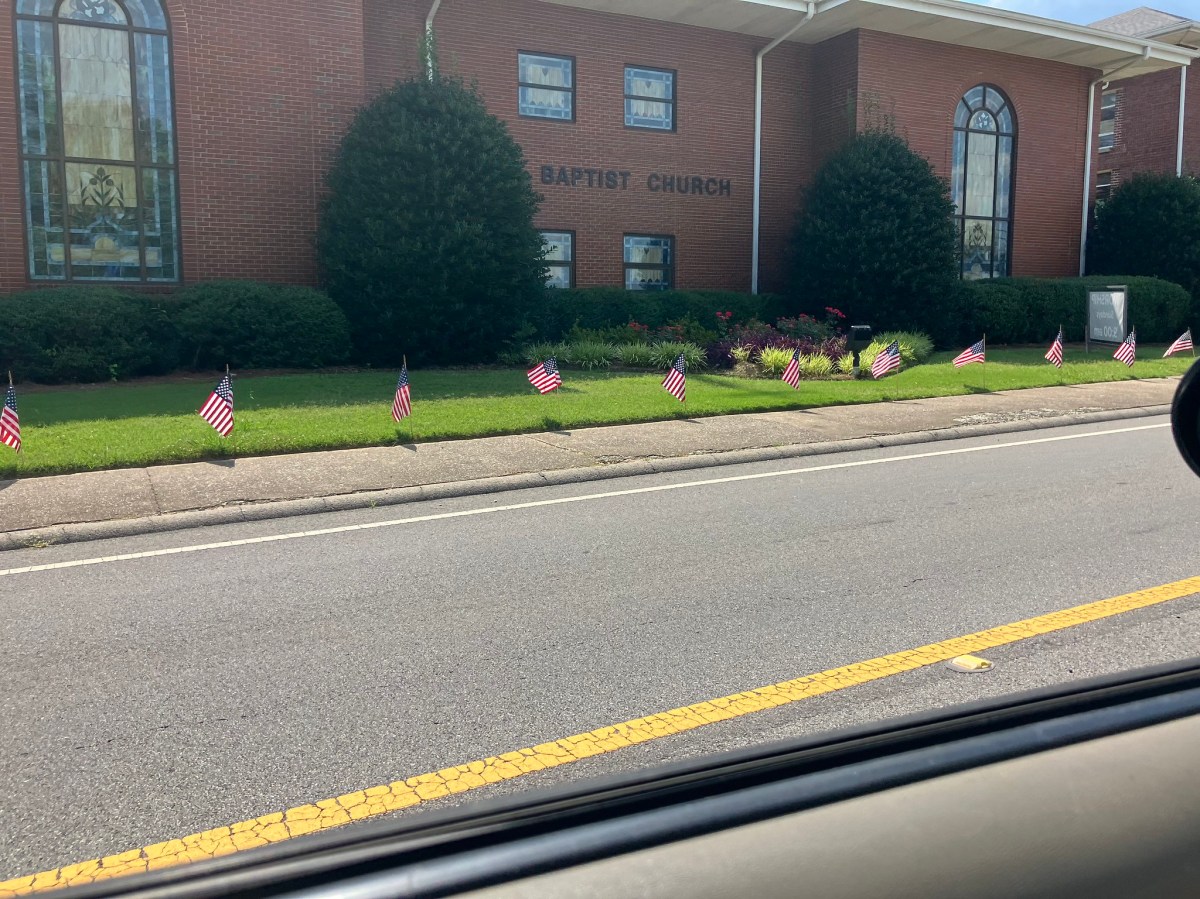
Yesterday, July 4th, I rode by First Baptist Church of Boaz and saw something that left me uneasy. Along the sidewalk, stretching across their front lawn, were dozens and dozens of tiny U.S. flags, each spaced out in a perfect, respectful row. It was clearly a tribute to America’s Independence Day — a show of patriotism. But in front of a church?

It struck me as a troubling symbol of how deeply certain forms of Christianity — especially Southern Baptist Fundamentalism — have tangled themselves up with nationalistic fervor. On the surface, maybe it looks harmless: honoring the nation, remembering veterans, celebrating the Fourth of July. But to me, those rows of flags waving proudly outside a place that claims to follow Jesus reveal something far more dangerous.

Let me be transparent. I do not believe Jesus was the supernatural Son of God described by Christian creeds. I do not believe He was divine, or that any divine being guided Him. And to be honest, I’m not even completely confident that Jesus the human, as described in the Gospels, actually existed. There may have been a historical teacher whose memory inspired the stories, but whether such a person truly lived is, for me, still an open question.

Still, if we work from the premise that someone named Jesus — a Galilean teacher — stood up against empire and religious hypocrisy, then what the Bible preserves about Him should at least partially represent a message that transcended nationalism. He proclaimed a kingdom “not of this world,” a movement that refused to be captured by flags or patriotic loyalty.

And that is exactly why this flag-lined church lawn is so disorienting. It seems to me that any honest reading of the New Testament would find a Jesus who taught about a kingdom beyond empires, militaries, or national symbols.

So why, then, do so many Southern Baptist churches embrace American flags as if they were sacred objects? Why conflate “God” with “country” so uncritically?

In my view, it comes down to comfort, nostalgia, and a need for belonging. If the church can wrap the cross in the stars and stripes, it doesn’t have to confront what Jesus (real or not) is said to have taught. It can claim to follow a crucified peasant from Galilee while at the same time feeling like it is on the winning team of history. It can baptize its political identity in religious language, and that feels safe.

But that is not Christianity, at least not in any sense that takes even the idea of Jesus seriously. That is civil religion — a convenient way to merge faith with patriotic sentiment, while ignoring any challenge to empire, power, and violence.

To me, those flags in front of First Baptist Boaz reveal what has gone wrong with so much American religion. The message is subtle but unmistakable: “You can have Jesus, but only if you pledge allegiance to this flag first.”

If there was ever a reason to question the fundamentalist version of Christianity, to pull back the layers and ask what really matters, this is it. I hope more people will pause, see those flags, and realize that maybe — just maybe — Jesus (if He even lived) would have walked right past them, still preaching a kingdom that had nothing to do with them at all.

Is Religion Dying or Evolving?

In the modern West, headlines regularly proclaim the “death of religion.” Pew Research, Gallup, and Barna surveys track the rising number of “nones”—those who identify with no religion. Church attendance has declined. Traditional doctrines are questioned. Even among professing believers, the enthusiasm for orthodoxy seems to be waning.

But is religion really dying?

Or is it evolving?

Let’s explore.


📉 The Decline of Traditional Religion

There’s no denying the numbers: in places like the U.S., Canada, and Europe, institutional religion is losing ground.

  • Church attendance is at historic lows.
  • Youth disaffiliation is accelerating.
  • Seminary enrollments are shrinking.
  • Pastoral burnout is surging.

Add to this the scandals, cover-ups, political entanglements, and doctrinal inflexibility that have left many questioning whether organized religion still serves the needs of real people in a real world.

But that’s only half the story.


🌱 The Rise of Spirituality and Hybrid Beliefs

While many are rejecting organized religion, they’re not rejecting meaning, purpose, or transcendence. In fact, millions are reimagining the spiritual quest on their own terms:

  • Mindfulness and meditation (often stripped of religious roots) are booming.
  • Spiritual-but-not-religious (SBNR) identifiers have exploded.
  • Interest in ancient wisdom, psychedelics, astrology, and Eastern philosophies continues to grow.
  • Interfaith dialogue, humanist communities, and progressive theologies are gaining traction.

What we’re witnessing may not be the death of religion, but the death of authoritarian, dogmatic religion—and the birth of something more human, flexible, and honest.


🧠 Evolution by Deconstruction

In biological terms, systems adapt or die. Religion is no different.

Many people today are going through faith deconstruction—not to destroy belief, but to evolve it. They are:

  • Letting go of fear-based doctrines.
  • Questioning literalist readings of ancient texts.
  • Replacing inherited guilt with critical inquiry.
  • Valuing ethics over orthodoxy.
  • Embracing community without creeds.

In this light, religion isn’t vanishing. It’s molting.

And like any molting creature, it looks messy in the process—but the goal is renewal.


🔍 What This Means for the Future

Will some religions die? Yes. Particularly those that refuse to adapt.

But the deeper human longings—connection, mystery, morality, hope—will remain. So too will our attempts to name and nurture them. What’s changing is the form:

  • Less hierarchy, more horizontal community.
  • Less dogma, more dialogue.
  • Less “you must believe,” more “let’s explore together.”

This is not a crisis. It’s a crossroads.


🧭 The God Question’s Invitation

We believe that belief should never require the suspension of thought.

That doubt is not the enemy of truth—but its companion.

And that religion, like every other human construct, must face the light of evidence, logic, and lived experience.

So ask yourself:

  • Is your faith expanding your mind—or shutting it down?
  • Is your spiritual community making room for questions—or punishing them?
  • Are you clinging to certainty—or growing in wonder?

Whether religion dies or evolves may depend on how bravely we ask—and live—the questions that matter.

Sunday Special Feature: The Flood, Fear, and the Problem With Pastor Tony’s Theology

At The God Question, we are committed to examining faith, evidence, and skepticism through structured discussions. But religion isn’t just an abstract debate—it’s happening all around us, shaping lives, influencing culture, and making bold claims that deserve scrutiny.

That’s why we offer Sunday Special Features—a weekly series where we critically analyze real-world religious messages, sermons, and events as they unfold.

Did a local pastor misrepresent science?

Is a faith-based organization making questionable claims?

Did a religious leader say something that needs to be fact-checked?

📌 Sunday Special Features will respond to these moments in real-time, helping readers think critically about the religious narratives they encounter in everyday life.

For this week’s Sunday Special Feature, we examine Pastor Tony Holcomb’s recent statements on the Beulah Bible Broadcast about the Noah’s Ark flood narrative. His central claim? That the biblical flood actually happened, that it was worldwide, and that modern science confirms it.

This post explores why that claim is completely false—and what it would say about God if it were true.


1️⃣ Pastor Tony’s Claims vs. Reality

In his sermon, Pastor Tony makes several bold claims about Noah’s flood, history, and science. Let’s break them down.


📌 CLAIM #1: The Flood Was a Real, Worldwide Event

Pastor Tony’s Claim: “The flood happened. It was worldwide. Noah was a real man. He did build an ark. These things happened. Why? Because God’s Word tells us they happened.”

This is a textbook example of circular reasoning:

  • The Bible is true because the Bible says it’s true.
  • The flood happened because Genesis says it did.

📌 The Reality: ✔ No independent historical records confirm a global flood.

✔ No geological evidence supports a worldwide deluge.

✔ No archaeological findings confirm the existence of Noah’s Ark.

🔹 The flood narrative is not history—it’s mythology.


📌 CLAIM #2: Jesus Confirmed That the Flood Was Real

Pastor Tony’s Claim: “Jesus reflects back on the flood as a historic worldwide flood, as a judgment of God upon the world.”

📌 The Reality:

  • If Jesus referenced Noah’s flood, that doesn’t confirm it happened.
  • People in the first century believed the flood was real—but belief doesn’t equal truth.
  • Using a story as an analogy doesn’t make it history.

If Jesus had referenced Zeus, would that mean Zeus is real?

If he mentioned the Tower of Babel, does that confirm its historicity?

📌 Quoting the Bible to prove the Bible is circular reasoning.


📌 CLAIM #3: The Grand Canyon Was Formed by Flood Runoff

Pastor Tony’s Claim: “Scientists and geologists, paleontologists, I mean, have looked at these things and have demonstrated through computer technology that the runoff of the flood is what created the Grand Canyon.”

📌 The Reality:

Geologists have extensively studied the Grand Canyon—its rock layers span nearly 2 billion years of Earth’s history.

The Colorado River carved the canyon gradually over the last 5 to 6 million years through erosion—not a single flood event.

If the canyon were caused by a global flood, we would see a single uniform layer of sediment—not distinct geological formations spanning vast timescales.

🔹 The Grand Canyon was not formed by Noah’s Flood—it’s a geological masterpiece shaped over millions of years.


📌 CLAIM #4: Noah’s Ark Has Been Found

Pastor Tony’s Claim: “They found what they believe is the Ark. Well, they have. And I don’t know. There’s a lot of different questions about that. But regardless of that, there’s so much evidence.”

📌 The Reality:

Every “discovery” of Noah’s Ark has turned out to be a hoax or a misinterpretation.

There is zero verified evidence that Noah’s Ark existed.

Many expeditions have claimed to find it—but none have stood up to scrutiny.

🔹 There is no ark. There never was. It’s a story—not a historical event.


2️⃣ Hypothetical: What If the Flood DID Happen?

But let’s set aside the evidence for a moment.

Let’s assume Pastor Tony is 100% correct—that the flood actually happened as described in Genesis.

What would that say about God?


📌 1. God Is Willing to Commit Global Genocide

✔ If the flood happened, then God deliberately killed nearly every human being—men, women, children, and even unborn babies—through drowning.

✔ If a human dictator wiped out an entire population, we would call it an atrocity.

✔ If Satan had done this, Christians would call him the ultimate villain.

📌 Key Question: If killing billions in a flood is “justice,” what would injustice look like?


📌 2. God Created Humans—Then Regretted It?

Genesis 6:6 says:

📌 “And the Lord regretted that he had made man on the earth, and it grieved him to his heart.”

Omniscience Problem → If God is all-knowing, why did He create humans knowing in advance that they would become wicked?

Omnipotence Problem → If God is all-powerful, why was genocide His only solution?

📌 Key Question: Why would a perfect, all-knowing God create a world He would later regret?


📌 3. The Flood Solved Nothing—Sin Still Exists

✔ Sin still exists.

✔ People are still corrupt.

✔ Evil still thrives in the world.

If the flood didn’t work, does that mean God’s plan failed?

📌 Key Question: If the flood was meant to “cleanse the world of sin,” why did it fail?


📌 3️⃣ Conclusion: The Flood Is a Myth, and That’s Okay

There is no scientific evidence of a global flood.

There is no historical or geological evidence of Noah’s Ark.

The Grand Canyon was not formed by a flood.

Jesus referencing the flood does not prove it happened.

The flood story exists to instill fear, not to reveal truth.

📌 Final Thought: Even if we grant every single one of Pastor Tony’s claims, the moral implications of the flood story should trouble any thinking person.

If the flood is just a myth, it’s a dangerous myth.

If the flood is real, then God is not loving, just, or merciful.

Either way, this isn’t a story of divine love or justice—it’s a warning about blind faith in cruel doctrines.


Sunday Special Feature: Does Science Lead to Despair? A Response to Pastor Tony Holcomb’s Sermon

Introducing Sunday Special Features on The God Question

At The God Question, we are committed to examining faith, evidence, and skepticism through structured discussions. But religion isn’t just an abstract debate—it’s happening all around us, shaping lives, influencing culture, and making bold claims that deserve scrutiny.

That’s why we’re introducing Sunday Special Features—a new weekly series where we critically analyze real-world religious messages, sermons, and events as they unfold.

Did a local pastor misrepresent science?

Is a faith-based organization making questionable claims?

Did a religious leader say something that needs to be fact-checked?

📌 Sunday Special Features will respond to these moments in real-time, helping readers think critically about the religious narratives they encounter in everyday life.

For our first Sunday Special Feature, we examine a claim made by Pastor Tony Holcomb of Beulah Baptist Church in a recent sermon. He argued that atheist philosophers and scientists see life as meaningless, and he used a famous quote from Carl Sagan to suggest that without faith in Jesus, the world is cold, depressing, and hopeless.

This post explores why that message misrepresents science and atheism.


📌 Now, back to our regularly scheduled post…

“Without God, There Is No Hope.”

What is Pastor Tony’s proof?

John 3:16, which he claims, gives people a real reason to hope, unlike the bleak worldview of science and atheism.

This claim is not only false—but deeply misleading.

Science does not strip life of meaning.

Atheists do not live in despair.

Carl Sagan was not promoting hopelessness—he was promoting awe.

Let’s break down Pastor Tony’s message and explore why a secular worldview is actually far more hopeful than the faith-based alternative.


1️⃣ Pastor Tony’s Straw Man: Misrepresenting Science & Atheism

📌 Pastor Tony’s Claim:

“Atheist philosophers and godless scientists tell us that life on planet Earth is meaningless and doomed to despair.”

This is a classic straw man argument—misrepresenting what atheists and scientists actually believe to make faith seem necessary.

🚨 The Reality: This Is Completely False

Science does not claim life is meaningless.

Atheists do not believe the world is “doomed to despair.”

Carl Sagan’s famous “Pale Blue Dot” quote is about responsibility, not hopelessness.

Pastor Tony is twisting Sagan’s words to make them sound cold and bleak, when in reality, Sagan’s message was deeply inspiring.

📌 Carl Sagan’s True Message:

  • We live on a tiny, fragile planet in a vast cosmos.
  • That means we should take care of each other, cherish life, and be responsible for our actions.
  • It’s up to us—not an outside force—to make life meaningful and just.

Pastor Tony wants his audience to fear a world without God. But fear isn’t a valid argument—it’s just a way to stop people from questioning.

📌 Key Takeaway: Science and atheism do not lead to despair. They lead to responsibility, curiosity, and meaning based on reality.


2️⃣ The False Dilemma: Faith or Hopelessness

Pastor Tony frames the world as having only two choices:

📌 Either believe in Jesus and have hope…

📌 …or reject faith and live in hopelessness.

This is a false dilemma because it ignores the real third option:

A meaningful, fulfilling, and purpose-driven life without religious faith.

✔ Science isn’t about providing comfort—it’s about discovering truth.

✔ Atheism doesn’t mean life has no meaning—it means meaning is something we create.

Truth isn’t determined by what makes us feel good—it’s determined by evidence.

📌 A comforting lie is still a lie.

The truth of a claim does not depend on how comforting it is.

✔ The idea that we go to heaven is comforting—but is it true?

✔ The idea that we have a divine plan is reassuring—but is there evidence?

✔ The idea that we were created for a purpose makes us feel special—but is it real?

Key Takeaway: The idea that you must choose between faith and despair is a false dilemma—one that religion uses to keep believers from questioning their assumptions.


3️⃣ Misunderstanding Evolution and Natural Processes

📌 Pastor Tony’s Claim:

“How could a world come into being out of random chance? How could there not be some purpose and meaning to life?”

This shows a fundamental misunderstanding of evolution and natural processes.

🚨 The Reality: Evolution Is Not Random Chance

The universe did not “come into being” by random chance.

Evolution is not purely random.

Natural selection is a filtering process that produces order, complexity, and intelligence—without needing a divine planner.

📌 The Truth About Evolution:

Mutations in DNA occur randomly.

But natural selection is NOT random—it selects traits that increase survival and reproduction.

✅ Over millions of years, this process produces complexity, intelligence, and adaptation.

Pastor Tony is unknowingly repeating one of the most common creationist misconceptions—equating evolution with pure randomness.

But natural selection is anything but random—it’s systematic, efficient, and beautifully complex.

📌 Key Takeaway: You are not here by divine design—but you are also not here by pure accident.

✔ You exist because of billions of years of natural selection—a process that is neither random nor divinely guided.


4️⃣ The Emotional Appeal of John 3:16

📌 Pastor Tony’s Claim:

“John 3:16 tells a very different story—that there is a rescuer, there is a savior, and we have a hope today in a living savior.”

📌 Reality Check:

John 3:16 is a religious claim—not a response to scientific truth.

Believing in a rescuer does not make one exist.

The “hope” Christianity offers is based on faith, not evidence.

This argument is purely emotional—not logical.

✔ He frames Carl Sagan’s quote as depressing and John 3:16 as uplifting.

✔ He uses emotion to persuade, rather than reason or evidence.

✔ He assumes hope only comes from Jesus, ignoring the many sources of secular meaning and joy.

The problem with religious hope is that it’s conditional—based on a belief system that cannot be proven true.

Key Takeaway: Christianity’s “hope” is not based on reality—it’s based on an emotional need for comfort.


5️⃣ The Truth About Meaning Without God

One of the most common misconceptions about atheism is that without a divine plan, life is meaningless. But that’s not true. Meaning is something we create—not something handed down from above.

📌 How Do Atheists Find Purpose?

Through relationships – Family, friendships, and love bring meaning.

Through passion – Art, science, writing, and personal projects give us fulfillment.

Through helping others – Morality doesn’t require religion. Helping people is meaningful because it improves lives.

Through curiosity and learning – Exploring the world and understanding the universe is deeply meaningful.

Key Takeaway: You weren’t placed here—but you are here. And that is enough.


📌 Conclusion: Truth Over Comfort

Pastor Tony distorts science to create a false sense of despair.

He uses a false dilemma to make faith seem necessary.

He misrepresents Carl Sagan’s words to push a misleading emotional contrast.

He misunderstands evolution and natural selection.

He replaces reason with emotional manipulation.

📌 Final Thought: You weren’t placed here—but you are here now. That’s enough. What you do with your life is up to you.

Looking Back, Moving Forward: The Journey Into Phase 2

For the past few weeks, we’ve laid the foundation for something bigger—an honest, critical, and open exploration of faith, reason, and the questions that matter.

We’ve taken time to define what this space is about: a place where we don’t settle for easy answers, where we dare to ask why we believe what we believe, and where faith and reason meet at a crossroads.

Now, it’s time to take the next step.


Where We’ve Been

Since launching, we’ve tackled some key themes that shape the discussions ahead:

🔹 The Importance of Questioning Belief – Why critical thinking isn’t an enemy of faith but a necessary part of understanding it.

🔹 Theological Fear vs. Intellectual Honesty – How fear-based teachings can discourage honest inquiry and how to move past them.

🔹 Faith, Doubt, and the Role of Reason – Examining whether belief and reason are at odds or if they can coexist.

🔹 Sunday Special Features – Deep dives into theological issues, exploring stories, doctrines, and perspectives that challenge conventional wisdom.

These discussions have set the stage for something more structured and in-depth.


Where We’re Going: Phase 2 Begins

Starting Tuesday, we’re shifting into Phase 2: Cycling Through All 11 Categories in Order (March 25 – April 29).

What does this mean? Instead of posting in a free-form way, we’ll be systematically working through each of the core themes that define this journey.

This will ensure that every major topic gets the depth, analysis, and conversation it deserves.

We’ll take our time. We’ll ask hard questions. And, most importantly, we’ll keep things clear, structured, and engaging.


What to Expect

💡 Each post (Tuesday and Friday), we’ll focus on a different major category—giving each topic space to be fully explored.

📖 Some posts will analyze scripture, history, and doctrine. Others will examine philosophy, science, and personal experience.

❓ We’ll raise questions without demanding specific answers—because thinking critically matters more than memorizing dogma.


Join the Conversation

This blog isn’t just about presenting ideas—it’s about engaging with them.

🔹 What topics are you most excited for?

🔹 What big questions have been on your mind?

🔹 What would you like to see explored in more depth?

Drop your thoughts in the comments or reach out directly. Your insights, questions, and challenges make these discussions richer.

Phase 2 begins Tuesday. Let’s keep the conversation going. 🚀

Why Are You Religious? The Power of Cultural Conditioning

For most believers, faith feels like a personal choice—a conscious commitment to God, truth, and morality. Many claim they follow their religion because it is correct, not because of where or how they were raised.

But what if belief isn’t as much about personal choice or divine truth as it is about environment and cultural conditioning?

The reality is that most people’s religious beliefs are inherited, not chosen. If you had been born in Saudi Arabia, you’d likely be Muslim. If you had been born in India, you’d likely be Hindu. If you grew up in a Mormon family in Utah, you’d likely be Mormon.

So, is religious belief really about truth—or is it about geography, upbringing, and cultural reinforcement?

Let’s examine how cultural conditioning shapes belief and why most people stay in the faith they were born into.


1️⃣ Religion Is Tied to Geography, Not Truth

One of the clearest pieces of evidence that religion is cultural, not divine, is the fact that beliefs are distributed by region—not by independent reasoning.

📌 The Religious Lottery: Where You’re Born Determines What You Believe
Christianity dominates the Americas and parts of Europe.
Islam is the majority religion in the Middle East and parts of Asia.
Hinduism is overwhelmingly concentrated in India.
Buddhism is deeply rooted in East Asia.
Judaism remains a minority faith, largely centered in Israel and the U.S.

If one religion were objectively true, wouldn’t we expect its followers to be spread evenly around the world—rather than clustered by geography?

📌 Key Point: Most believers hold their faith not because they independently analyzed every religion and chose the “correct” one, but because they were raised in it.


2️⃣ Childhood Indoctrination: Belief Before Reason

🔹 Religious belief is often instilled long before critical thinking develops.
🔹 Children are taught that faith is a virtue—believing without question is rewarded, while doubt is discouraged or even punished.
🔹 This creates a mental framework where religion feels “natural”, making it harder to question later in life.

📌 The “Santa Claus Effect”

✔ As children, we believe what authority figures tell us—including Santa, the Tooth Fairy, and religious teachings.
✔ Over time, we outgrow childhood myths—but religion is reinforced through cultural rituals, social pressures, and community identity.
✔ The difference? There is no lifelong social pressure to keep believing in Santa.

📌 Key Point: Most people believe because they were taught to believe—not because they discovered it on their own.


3️⃣ Social Pressure: Religion as a Cultural Identity

🔹 In many cultures, religion is more than just a belief system—it’s an identity.
🔹 Questioning faith isn’t just about ideas—it’s about belonging, acceptance, and social consequences.

📌 How Social Pressure Reinforces Faith

Family Expectations – Many believers stay religious to avoid disappointing their families.
Community Influence – Churches, mosques, temples, and synagogues create tight-knit social groups that make it difficult to leave.
Fear of Rejection – In highly religious areas, doubting faith can mean losing friendships, family support, or even employment opportunities.

📌 Example: In highly religious communities like the Bible Belt (U.S.) or conservative Islamic countries, questioning faith can lead to isolation, rejection, or persecution.

Key Point: For many, remaining religious isn’t about belief—it’s about survival in a faith-based culture.


4️⃣ The Fear Factor: Religious Conditioning and Anxiety

Many religions use fear as a tool to maintain belief.

🔹 Fear of Hell – One of the strongest deterrents to questioning faith is the idea of eternal punishment.
🔹 Fear of the Unknown – People are more likely to cling to religious beliefs if they fear death, meaninglessness, or uncertainty.
🔹 Fear of Losing Purpose – Many believers feel that without religion, life would have no meaning.

📌 Thought Experiment: What If Hell Didn’t Exist?

If religions didn’t include threats of hell or divine punishment, how many people would remain faithful?

📌 Key Point: Fear keeps people from questioning—not because their religion is true, but because they are conditioned to avoid doubt.


5️⃣ How Religious Beliefs Survive (Even When They’re Wrong)

🔹 Cognitive Biases Keep Believers Trapped

Confirmation Bias – Believers focus on information that supports their faith and ignore contradictory evidence.
Cognitive Dissonance – When faced with facts that contradict their beliefs, believers rationalize them away rather than changing their views.
The Backfire Effect – When religious people are confronted with evidence against their faith, they often double down rather than reconsider.

📌 Example: A Christian who is shown biblical contradictions may reinterpret them rather than accept that the Bible has flaws.


6️⃣ Breaking Free: How Some People Escape Religious Conditioning

🔹 While most people remain in their inherited religion, some break free. What makes them different?

Critical Thinking – They ask hard questions and seek evidence.
Exposure to Different Beliefs – Learning about other religions helps people see how arbitrary faith can be.
Emotional Detachment – They stop basing belief on fear and start valuing reason.

📌 Key Point: The difference between staying religious and leaving faith often comes down to curiosity, critical thinking, and the willingness to question deeply held beliefs.


📌 Conclusion: Religion Is Cultural, Not Divine

Most people follow the religion they were born into—not because it’s true, but because they were raised with it.
Religious beliefs cluster geographically, suggesting they are a product of culture, not divine truth.
Fear, social pressure, and cognitive biases keep many people from questioning their faith.
Breaking free requires critical thinking, exposure to different perspectives, and a willingness to challenge deeply held assumptions.

📌 Final Thought: If you had been born in a different country, you would likely follow a different religion. What does that say about the truth of your beliefs?


📌 What to Read Next

📺 The Psychology of “Answered” Prayers (Why believers think their prayers are answered—even when they aren’t.)

📺 Does Morality Require God? (Exploring whether moral values can exist without divine command.)

💡 What do you think? Do people choose their religion, or is it chosen for them by culture? Let’s discuss in the comments!