Losing Faith, Gaining Freedom: My Deconversion Story


“I didn’t stop believing because I wanted to sin. I stopped believing because I started asking better questions.”

For years, I was immersed in a belief system that promised certainty, salvation, and community. It answered all the big questions—where we came from, what we’re here for, and what happens when we die. But eventually, those neat answers began to feel like tightly sealed boxes, not doors to discovery. The more I studied, questioned, and listened—especially to the small, persistent voice of doubt—the more I realized my faith was built on fear, tradition, and emotional manipulation, not truth.

This is my deconversion story.


The Questions That Wouldn’t Go Away

It didn’t begin with rebellion. It began with sincerity. With Bible reading. With prayer. I wanted to understand God better. But I kept encountering contradictions—within the Bible itself, between the character of God and the horrors of hell, between what I was told to believe and what I knew deep down was moral and just.

The resurrection, I was told, was the ultimate proof. But I came to realize that it wasn’t. The “evidence” was weak. The emotional pressure to believe was strong. And the cost of asking hard questions was often isolation and judgment.

What kind of truth needs to be propped up by fear of hell?


A God Too Small

I believed in a God who demanded blood to forgive, who created people knowing most would suffer eternally, who answered some prayers but not others—and we were never allowed to ask why. Any doubt was labeled as rebellion. Any critique, as pride. But the God I was supposed to worship felt more like a cosmic tyrant than a loving father.

My deconstruction was slow, layered, and painful. But when I finally let go of the idea that the Bible was inerrant—that was the turning point. The house of cards began to fall. And I didn’t crumble with it. I grew.


What I Found Instead

When I stopped clinging to faith, I didn’t become lost. I became more grounded. More human. More empathetic. I discovered wonder not in dogma but in reality—in science, in philosophy, in the beauty of questions without tidy answers. I stopped fearing hell and started loving life.

And here’s what surprised me most: the world didn’t become darker. It became brighter. I didn’t lose meaning—I began to build my own.


If You’re Deconstructing

You’re not alone. Millions of people are questioning their faith—especially those raised in high-control religious environments like Southern Baptist fundamentalism. Deconstruction isn’t rebellion. It’s growth. It’s an act of courage. And walking away from belief doesn’t mean walking away from morality, wonder, or purpose. It often means reclaiming them.


📺 For Further Exploration:

A moving, funny, and deeply honest account of one woman’s deconversion journey.


🧠 Thought to Ponder: If you were born in a different country, to different parents, would you still believe what you do now? If not, what does that say about your faith?

How to Spot Logical Fallacies in Religious Debates

When someone makes a bold religious claim—especially one involving supernatural events, eternal rewards or punishments, or divine authority—it can be difficult to know how to respond. The language is often emotional. The audience is expected to accept things on faith. And the pressure to conform can be overwhelming.

But there is one powerful tool we can all learn to use: logic.

If you want to evaluate religious claims with a clear mind, start by learning how to spot logical fallacies—errors in reasoning that can mislead even the most intelligent among us. Today, we’ll explore some of the most common fallacies found in religious debates, and how to recognize them in action.


🚩 1. Appeal to Authority

Fallacy: “The Bible says it, so it must be true.”
Why it fails: Just because a source claims authority doesn’t mean it’s reliable. All ancient texts—including religious ones—must be evaluated on historical, logical, and evidentiary grounds. The claim that a book is divine cannot be the evidence for its divinity.

🔎 Ask this instead: What objective evidence shows this authority is trustworthy?


🚩 2. Circular Reasoning

Fallacy: “Jesus must be God because the Bible says so, and the Bible must be true because Jesus is God.”
Why it fails: The argument relies on its own conclusion to prove itself—offering no independent evidence.

🔎 Ask this instead: Is there any way to test this claim without assuming it’s already true?


🚩 3. Appeal to Consequences

Fallacy: “If you don’t believe, you’ll go to Hell.”
Why it fails: Whether a belief has good or bad consequences has nothing to do with whether it’s true. Fear of punishment or hope of reward is a tool of emotional coercion—not rational argument.

🔎 Ask this instead: What does the actual evidence say about the claim, regardless of how it makes me feel?


🚩 4. False Dichotomy

Fallacy: “Either Jesus is Lord, or he was a liar or lunatic.”
Why it fails: This trilemma (popularized by C.S. Lewis) ignores many other possibilities—such as legend, exaggeration, or error in transmission over centuries.

🔎 Ask this instead: Are there more than two (or three) explanations for the evidence?


🚩 5. Burden of Proof Reversal

Fallacy: “You can’t prove God doesn’t exist, so He must.”
Why it fails: The person making the claim has the responsibility to prove it. If I claim there’s an invisible dragon in my garage, it’s not up to you to disprove it—it’s up to me to demonstrate it.

🔎 Ask this instead: What direct, falsifiable evidence supports this claim?


🧭 The Bottom Line

When religious beliefs are discussed, the bar for truth often gets lowered in the name of faith. But beliefs that shape lives, relationships, and public policy deserve just as much scrutiny as any other claim about the world.

By learning to spot logical fallacies, you gain clarity—and give yourself permission to ask better questions.

Why the Resurrection Never Happened — And Why That Matters

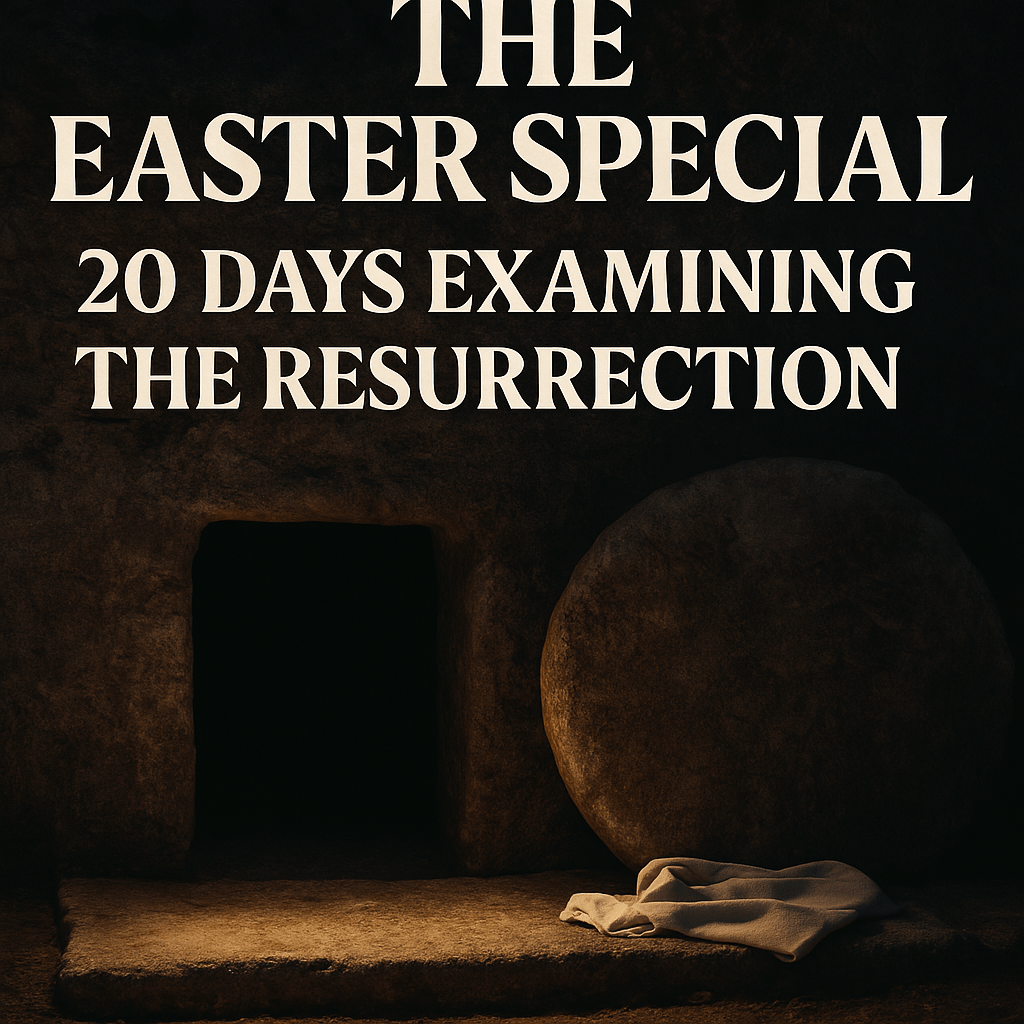
📅 Today is Day 20 of The 20-Day Easter Special

🚨 Let’s Say It Plainly

After twenty days of scrutiny—comparing claims, dissecting texts, exploring psychology, history, theology, and myth—we’re ready to say what many suspect, and some already know:

The resurrection of Jesus never happened.

Not in the literal, physical, historical sense claimed by most Christians.

Not as an actual dead man walking out of a tomb in Roman-occupied Judea.

And not in any way that should command our moral allegiance, public policy, or existential loyalty.

Let’s break down why.


🧭 Reapplying The God Question’s Core Philosophy

  1. Does the resurrection claim rely on evidence or belief?
  2. Are alternative explanations considered?
  3. Is there independent corroboration?
  4. Is the claim falsifiable?
  5. Does the explanation raise more questions than it answers?

After applying these questions to every aspect of the Easter story, here’s what we found:


1. 🔍 It Relies on Belief, Not Evidence

There is no verifiable evidence that Jesus came back from the dead. All claims stem from internal Christian writings—none contemporary, none neutral, and none coherent.

  • No tomb confirmed.
  • No body found.
  • No names on eyewitness accounts.
  • No Roman records.
  • No Jewish documentation.

Belief fills the gaps—and then dares us to call that “faith.”


2. 🔁 Alternative Explanations Fit Better

Everything in the resurrection narrative has naturalistic explanations that are far more plausible:

  • Apparitions and visions? Common after traumatic death.
  • Empty tomb? A later legend.
  • Devotion despite death? So did followers of Osiris, Mithras, and countless others.

Christianity is not unique. It is a cultural remix of dying-and-rising myths, made palatable to Greco-Roman ears.


3. 🔗 No Independent Corroboration Exists

No outside historian mentions the resurrection until long after the supposed event. Even early Christian writings—Paul’s letters—say almost nothing about an empty tomb or physical sightings.

If a dead man truly rose and appeared to hundreds, it’s strange no one beyond the movement cared enough to mention it.


4. ❌ The Claim Is Unfalsifiable

The beauty of the resurrection myth (for the believer) is that it’s immune to failure:

  • Don’t find evidence? “Blessed are those who believe without seeing.”
  • Find contradictions? “Each account adds richness.”
  • Don’t feel God? “You must be hardened by sin.”

Nothing can prove it false—so nothing can prove it true.


5. ❓ It Creates More Confusion Than Clarity

A god-man must die to appease himself so he can forgive us for what he created us to be?

That’s not just illogical—it’s morally incoherent.

And it asks us to worship the system that created the pain.

The resurrection myth encourages passivity in the face of injustice (“Jesus will fix it in the next life”) and emotional manipulation (“He died for you—what will you do for him?”).

It demands surrender, not inquiry. Loyalty, not logic.


✊ Why It Matters

Some will say: “Even if it’s not true, the resurrection inspires hope.”

But false hope is not harmless:

  • It’s used to justify suffering (“your pain has purpose”).
  • It’s used to cover corruption (“don’t worry, God will judge in the end”).
  • It’s used to escape reality (“this life doesn’t matter as much as the next one”).

If the resurrection never happened, then we—humans—are responsible for building meaning, fixing injustice, and finding hope in one another.

And that’s not bad news.

That’s the beginning of honest, grounded, collective morality.


🧭 The God Question’s Final Invitation

The resurrection myth is beautiful, ancient, poetic—and false.

But that doesn’t leave us empty. It frees us.

It frees us to grieve without platitudes. It frees us to ask without shame. It frees us to love without fear. It frees us to build a better world—not because God will fix it, but because no one else will.

And that’s why truth matters.

Let’s keep asking. Let’s keep building.


📺 For Further Exploration

Video: The Resurrection: A Critical Examination of The Easter Story – Jonathan MS Pearce (Part 1)

Overview: In this in-depth discussion, philosopher and author Jonathan MS Pearce delves into his book The Resurrection: A Critical Examination of the Easter Story. He systematically analyzes the resurrection narratives, highlighting inconsistencies and exploring naturalistic explanations.


📅 Note: After we wrap up our 20-Day Easter Special on April 20, we’ll return to our regular schedule of posting three times a week:

  • Tuesdays & Fridays – our structured explorations through all 11 blog categories
  • Sundays – our Sunday Special Feature, where we critically respond to real-world religious claims in real time

We hope you’ll stay with us as we continue asking bold questions and applying reason to faith.

How to Think Critically About the Resurrection

📅 Today is Day 19 of The 20-Day Easter Special

Each day leading up to Easter, we’re critically examining a core resurrection claim—one at a time—through the lens of reason, evidence, and The God Question’s Core Philosophy.

🧩 The Central Question

Christians often declare: “The resurrection is the best explanation for the evidence!” But what happens when we actually apply critical thinking?

Today, we’re not asking what to believe—we’re asking how to think. Specifically, how to evaluate the resurrection claim with the same logic we’d apply to anything else.


🧭 Apply The God Question’s Core Philosophy

  1. Does the claim rely on evidence or belief?
  2. Are alternative explanations considered?
  3. Is there independent corroboration?
  4. Is the claim falsifiable?
  5. Does the explanation raise more questions than it answers?

Let’s examine how the resurrection fares under these five filters of reason.


1. 🔍 Does the Claim Rely on Evidence or Belief?

The resurrection is based entirely on ancient, anonymous texts. We have no eyewitness testimony—not in the modern sense. The Gospels were written decades later, by unknown authors, in communities already devoted to Jesus.

In most areas of life, we demand strong, first-hand evidence. Imagine trying to prove a dead man came back to life using only third-hand blog posts written 40 years later by his followers.

Yet in religion, belief is often treated as its own evidence.

Critical Thinking Tip: Belief may motivate—but it doesn’t validate.


2. 🔁 Are Alternative Explanations Considered?

A critical thinker doesn’t jump to conclusions—they ask:

  • Could the tomb story be a legend?
  • Could the appearances be dreams, visions, or grief-induced hallucinations?
  • Could the resurrection motif have grown over time to elevate Jesus’ status?

Christian apologists rarely explore these possibilities in good faith. Instead, they leap from “the tomb was empty” (which isn’t even verifiable) to “therefore, God raised Jesus.”

That’s a non sequitur—a conclusion that doesn’t follow from the premise.

Critical Thinking Tip: Consider all the possibilities. Then weigh them, not by what you want to be true, but by what best fits the evidence.


3. 🔗 Is There Independent Corroboration?

Critical thinking requires corroboration from multiple, independent sources.

For the resurrection, we have:

  • No physical evidence
  • No external confirmation from Roman records or first-century historians
  • No contemporary mentions of a public execution followed by a mass resurrection event

All “supporting sources” are internal: the New Testament writers themselves. And they don’t even agree on the details.

Critical Thinking Tip: When all the “evidence” comes from insiders, ask what outsiders had to say—and why they didn’t say it.


4. ❌ Is the Claim Falsifiable?

Can the resurrection be proven false?

  • If the tomb is empty: “He is risen!”
  • If the tomb is occupied: “You’ve got the wrong tomb.”
  • If people report visions: “Proof of resurrection!”
  • If no one reports visions: “They were afraid to speak!”

A belief that explains every outcome explains nothing.

Critical Thinking Tip: If a claim can’t be tested or disproven—even in theory—it doesn’t belong in the realm of knowledge. It belongs in the realm of imagination.


5. ❓ Does the Explanation Raise More Questions Than It Answers?

Saying “God raised Jesus” immediately invites deeper problems:

  • Why wait three days?
  • Why appear only to a select few?
  • Why allow confusion, contradictions, and decades of oral storytelling before documentation?
  • Why choose a time and place (1st-century Palestine) where no one could verify any of this?

These aren’t minor narrative quirks. They are logical red flags.

Critical Thinking Tip: A good explanation simplifies. A poor one multiplies mystery.


🧠 Final Thought: Start with the Method, Not the Conclusion

Critical thinking isn’t about debunking. It’s about pausing. Asking. Testing. Refusing to confuse desire for truth with truth itself.

The resurrection might be comforting. It might be inspiring. But that doesn’t make it true.

Only one thing earns that label: evidence, examined with rigor.


🧭 The God Question’s Invitation

The resurrection is Christianity’s central claim. But no belief—however sacred—is above scrutiny.

If a belief is true, it can withstand your questions. If it isn’t, it shouldn’t survive your trust.

Let’s keep asking.


📺 For Further Exploration

Video: Secrets of the Psychics – NOVA Documentary

Overview: This classic NOVA documentary features renowned skeptic James Randi as he investigates claims of paranormal abilities and miracles. Through demonstrations and critical analysis, Randi exposes the techniques used by self-proclaimed psychics and faith healers, emphasizing the importance of skepticism and scientific inquiry.​


📅 Note: After we wrap up our 20-Day Easter Special on April 20, we’ll return to our regular schedule of posting three times a week:

  • Tuesdays & Fridays – our structured explorations through all 11 blog categories
  • Sundays – our Sunday Special Feature, where we critically respond to real-world religious claims in real time

We hope you’ll stay with us as we continue asking bold questions and applying reason to faith.

Looking Back, Moving Forward: The Journey Into Phase 2

For the past few weeks, we’ve laid the foundation for something bigger—an honest, critical, and open exploration of faith, reason, and the questions that matter.

We’ve taken time to define what this space is about: a place where we don’t settle for easy answers, where we dare to ask why we believe what we believe, and where faith and reason meet at a crossroads.

Now, it’s time to take the next step.


Where We’ve Been

Since launching, we’ve tackled some key themes that shape the discussions ahead:

🔹 The Importance of Questioning Belief – Why critical thinking isn’t an enemy of faith but a necessary part of understanding it.

🔹 Theological Fear vs. Intellectual Honesty – How fear-based teachings can discourage honest inquiry and how to move past them.

🔹 Faith, Doubt, and the Role of Reason – Examining whether belief and reason are at odds or if they can coexist.

🔹 Sunday Special Features – Deep dives into theological issues, exploring stories, doctrines, and perspectives that challenge conventional wisdom.

These discussions have set the stage for something more structured and in-depth.


Where We’re Going: Phase 2 Begins

Starting Tuesday, we’re shifting into Phase 2: Cycling Through All 11 Categories in Order (March 25 – April 29).

What does this mean? Instead of posting in a free-form way, we’ll be systematically working through each of the core themes that define this journey.

This will ensure that every major topic gets the depth, analysis, and conversation it deserves.

We’ll take our time. We’ll ask hard questions. And, most importantly, we’ll keep things clear, structured, and engaging.


What to Expect

💡 Each post (Tuesday and Friday), we’ll focus on a different major category—giving each topic space to be fully explored.

📖 Some posts will analyze scripture, history, and doctrine. Others will examine philosophy, science, and personal experience.

❓ We’ll raise questions without demanding specific answers—because thinking critically matters more than memorizing dogma.


Join the Conversation

This blog isn’t just about presenting ideas—it’s about engaging with them.

🔹 What topics are you most excited for?

🔹 What big questions have been on your mind?

🔹 What would you like to see explored in more depth?

Drop your thoughts in the comments or reach out directly. Your insights, questions, and challenges make these discussions richer.

Phase 2 begins Tuesday. Let’s keep the conversation going. 🚀

How to Debate a Believer Without Losing Your Cool

“Why don’t you believe in God?”

If you’ve ever engaged in a conversation about faith, you know how quickly things can turn heated, frustrating, or downright exhausting. For many believers, faith isn’t just a belief—it’s their identity, their source of comfort, and a deeply personal conviction.

As a skeptic or nonbeliever, debating a religious person can feel like arguing against emotion, tradition, and ingrained assumptions all at once. It’s easy to become frustrated, defensive, or even condescending—none of which helps in having a productive conversation.

So, how do you engage in meaningful, rational discussions with believers—without losing your patience? Here are key strategies to keep your cool and make your points effectively.


1️⃣ Understand the Goal: Conversation, Not Conversion

You’re not going to “win” the debate.

You’re not going to deconvert someone on the spot.

If your goal is to “prove them wrong, “ you’ve already lost. Belief change is a slow process, and most people won’t abandon faith just because they lost an argument. Instead of trying to convert them to skepticism, shift your goal to:

✅ Encouraging critical thinking

✅ Helping them question their assumptions

✅ Keeping the conversation open and respectful

Why It Matters: Most believers won’t remember your exact arguments—but they will remember how you made them feel. If they walk away feeling attacked, they’ll dig in deeper. If they walk away curious and respected, they might start questioning on their own.


2️⃣ Ask More Questions Than You Answer

✔ Instead of telling them why their beliefs are wrong, ask them to explain their reasoning.

✔ Make them do the intellectual heavy lifting.

📌 Examples: ❌ Instead of: “Your belief in miracles is irrational.”

✅ Ask: “How do you determine whether a miracle actually happened?”

❌ Instead of: “The Bible is full of contradictions.”

✅ Ask: “If two passages contradict each other, how do you decide which one to follow?”

This forces them to engage with their own beliefs critically, instead of just defending them from attack.


3️⃣ Stay Calm—Their Emotions Aren’t Yours

✔ Many believers react emotionally when their faith is challenged.

✔ They may get defensive, angry, or even insult you.

✔ Remember: Their emotions are about them, not about you.

📌 When They Get Defensive: ❌ Don’t respond with frustration or condescension.

✅ Stay calm and neutral.

📌 If They Attack You Personally: ❌ Don’t take the bait.

✅ Say: “I’m here to discuss ideas, not attack you personally.”

Keeping your emotions in check gives you the upper hand—because once emotions take over, logic gets thrown out the window.


4️⃣ Keep It About Ideas, Not People

✔ Attack arguments, not the person.

✔ Even if you think their beliefs are irrational, don’t call them irrational.

✔ Avoid insults, sarcasm, or belittling language.

📌 Instead of:“Belief in God is stupid.”

Say: “I don’t see any compelling evidence for God’s existence.”

📌 Instead of:“You’ve been brainwashed into believing this.”

Say: “It makes sense that you believe this, given how we’re all raised in certain traditions.”

Making it personal makes them defensive.

Keeping it intellectual keeps the discussion productive.


5️⃣ Use the “Steel Man” Technique (Understand Their Strongest Argument)

🔹 Instead of straw-manning their argument (misrepresenting it in a weaker form), try steel-manning it:

✔ Restate their position as clearly and strongly as possible—so that they feel understood.

✔ THEN, explain why you disagree.

📌 Example:

🔹 Believer: “Everything in the universe is so finely tuned for life. That’s evidence for a creator.”

🔹 Steel-Man Response: “I see what you’re saying—if the universe were even slightly different, life as we know it wouldn’t exist. It seems designed. But what if we’re just one of many possible universes, and this one happened to support life?”

✔ This shows respect while still challenging their assumption.

✔ It also keeps them listening instead of shutting down.


6️⃣ Know When to Walk Away

✔ Some debates aren’t worth having.

✔ If the person is hostile, unwilling to listen, or just wants to “win,” it’s okay to exit.

📌 How to End the Conversation Gracefully:

“It’s clear we see this differently, but I’ve enjoyed discussing it with you.”

“I appreciate the conversation—I think we’ll have to agree to disagree on this one.”

“This is an important topic, but I don’t think we’re making progress right now. Let’s leave it here.”

✔ Some people aren’t debating in good faith—and your time is valuable.


7️⃣ Let the Conversation Be a Seed, Not a Battle

Your goal isn’t to “win”—it’s planting a seed of doubt.

✔ People rarely change their minds on the spot, but they do start thinking later.

🔹 The best debates end with curiosity, not conversion.

🔹 If they go home thinking, “Hmm… I never thought of that,” then you’ve already succeeded.

✔ The most effective “debaters” aren’t aggressive or confrontational—they’re the ones who make people question their own certainty.


📌 Conclusion: Debate With Curiosity, Not Anger

Debating a believer isn’t about winning—it’s about engaging.

Keep your cool.

Ask questions instead of attacking.

Challenge ideas, not people.

Know when to walk away.

Remember: Change happens slowly.

📌 A productive conversation doesn’t end in victory—it ends in thought.


📌 What to Read Next

📺 Why I Left Religion After 60 Years of Faith(My personal deconversion story and what led me to question my beliefs.)

📺 Does Prayer Really Work?(Analyzing whether prayer has real-world effects or is just confirmation bias.)


💡 What’s your experience debating believers?

Have you ever had a discussion that changed someone’s mind—or your own?

Drop a comment below!

Why I Left Religion After 60 Years of Faith

A Journey from Deep Belief to Skepticism

For 60 years, I was a committed Southern Baptist. I read my Bible, prayed daily, attended church faithfully, and truly believed I had a personal relationship with God. My faith was the foundation of my life—it gave me purpose, shaped my decisions, and provided what I thought was absolute truth.

Then, everything changed.


🔹 A Life Built on Faith

I wasn’t just a casual believer—I was deeply involved in my church and community. My faith wasn’t a Sunday-only commitment; it was woven into every aspect of my life.

✔ I trusted the Bible as the inspired Word of God.

✔ I prayed with conviction, believing my prayers were heard.

✔ I evangelized and shared my faith with others.

✔ I never doubted—until the day I did.


🔹 The First Cracks in My Faith

Looking back, I realize my faith had small cracks for years, but I ignored them. Whenever I encountered difficult questions, I did what every faithful believer does: I prayed, sought guidance, and reaffirmed my trust in God.

But certain questions refused to go away.

1️⃣ The Problem of Evil & Suffering

I couldn’t reconcile the idea of a loving, all-powerful God with the overwhelming suffering in the world.

  • Why does God allow innocent children to die from disease and starvation?
  • Why do natural disasters wipe out thousands of lives in an instant?
  • Why does God remain silent while people cry out for help?

Every answer I received felt hollow:🗣 “God works in mysterious ways.”🗣 “Suffering is part of His divine plan.”🗣 “We can’t understand His wisdom.”

But if I couldn’t understand God, how could I trust Him completely?

2️⃣ Prayer: A One-Way Conversation

For years, I truly believed that prayer worked. I felt comforted, reassured, and connected to God whenever I prayed.

But one day, I asked myself: “If prayer works, why does it look exactly like coincidence?”

  • If a sick person recovers, we say, “God answered our prayers.”
  • If they die, we say, “God had a different plan.”
  • If nothing happens, we say, “Keep praying—God’s timing is perfect.”

No matter what the outcome, we always found a way to credit God—even when it was clear that prayer had no measurable effect.

If God was truly all-powerful and interactive, why did He never provide clear, undeniable answers?

3️⃣ The Bible’s Inconsistencies

The more I studied the Bible, the more I noticed contradictions and moral problems I had previously overlooked.

  • Why does the Old Testament portray a vengeful, wrathful God while the New Testament promotes love and forgiveness?
  • Why does God command genocide, slavery, and stoning in the Old Testament but condemn sin in the New Testament?
  • Why are there so many contradictions between the Gospel accounts of Jesus’ life?

For decades, I convinced myself that the Bible had no errors—that any contradiction could be explained. But the deeper I studied, the more I realized that I was forcing the pieces to fit rather than accepting that the Bible was flawed.


🔹 The Moment I Stopped Believing

There wasn’t a single “aha” moment where I suddenly became an atheist. It was a slow, painful process.

I fought to keep my faith. I prayed more, studied harder, and asked pastors for guidance. But instead of finding reassurance, I found more doubts.

Then, one day, I realized something terrifying:I didn’t believe anymore.

I wasn’t rejecting God because I wanted to sin. I wasn’t “angry at God.” I wasn’t looking for excuses.

I simply realized that there was no reason to believe anymore.


🔹 Life After Faith: What I Gained

Leaving Christianity wasn’t easy. I lost the certainty and comfort that faith provided. But I also gained something unexpected:

Freedom – No more cognitive dissonance, no more justifying contradictions.

Honesty – I could finally admit that I didn’t have the answers—and that’s okay.

A New Perspective – I saw the world through evidence and reason rather than faith.

Authenticity – I no longer had to pretend to believe in something I knew wasn’t true.

Many believers assume that losing faith means losing morality, purpose, and meaning. But that couldn’t be further from the truth.

🚀 I didn’t lose meaning—I created it.


🔹 What I Want for You

If you’re reading this, you might be questioning your faith, or maybe you’re a believer who wants to understand why some people leave religion.

I’m not here to attack believers—I was one for most of my life. I know how deeply personal and emotional faith is.

But I do want to challenge you to think critically. Ask questions. Demand evidence. Follow the truth—wherever it leads.


✉️ Join the Conversation

What about you? Have you questioned your faith? Are you a believer who sees things differently?

👇 Drop a comment below—I’d love to hear your thoughts.

Welcome to The God Question

Is Belief in God Rational? Let’s Examine the Evidence.

For much of my life, I accepted God’s existence without question. Faith provided comfort, certainty, and a framework for understanding the world. But as I began to critically examine my beliefs, I encountered an unsettling thought: What if I’ve been mistaken?

This question is not an attack on faith—it’s an invitation to investigate. If God exists, shouldn’t the evidence be undeniable? If He doesn’t, why do so many people believe?

The Problem with Faith as Evidence

Religious belief is often sustained by faith, but is faith a reliable path to truth? If faith can justify belief in any god—Jesus, Allah, Krishna, or Zeus—how do we determine which is correct? Can personal conviction alone serve as proof?

Where Science and Reason Fit In

Science demands testable claims and repeatable evidence, yet religious belief often relies on personal experience and ancient texts. If we used faith-based reasoning in medicine or law, would we trust the results?

An Invitation to Question

I don’t claim to have all the answers, but I do believe that questioning is the first step toward understanding. Here at The God Question, we explore topics like:

  • Is there verifiable evidence for God?
  • Why do people cling to faith despite contradictions?
  • Can morality exist without religion?
  • What psychological and cultural forces sustain belief?

This blog isn’t about rejecting faith outright—it’s about exploring the hard questions that many hesitate to ask.

Join the Conversation

If you’ve ever doubted, wondered, or sought deeper clarity, you’re in the right place. Let’s examine the evidence, challenge assumptions, and search for truth—wherever it may lead.

🔹 Read the Blog – Start exploring the questions that matter.🔹 Subscribe – Get updates on new posts.🔹 Share Your Thoughts – Engage in meaningful discussion.