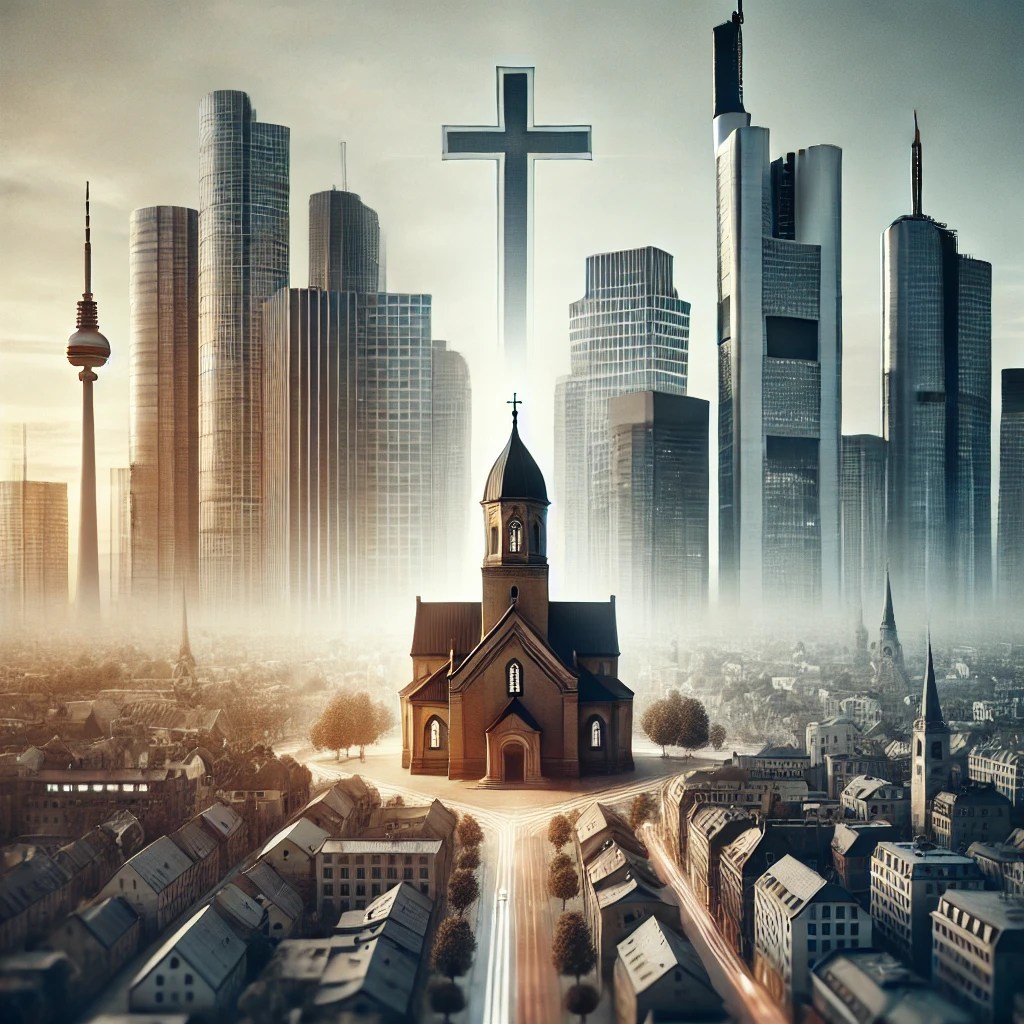
Is Religion Dying or Evolving?

In the modern West, headlines regularly proclaim the “death of religion.” Pew Research, Gallup, and Barna surveys track the rising number of “nones”—those who identify with no religion. Church attendance has declined. Traditional doctrines are questioned. Even among professing believers, the enthusiasm for orthodoxy seems to be waning.

But is religion really dying?

Or is it evolving?

Let’s explore.


📉 The Decline of Traditional Religion

There’s no denying the numbers: in places like the U.S., Canada, and Europe, institutional religion is losing ground.

  • Church attendance is at historic lows.
  • Youth disaffiliation is accelerating.
  • Seminary enrollments are shrinking.
  • Pastoral burnout is surging.

Add to this the scandals, cover-ups, political entanglements, and doctrinal inflexibility that have left many questioning whether organized religion still serves the needs of real people in a real world.

But that’s only half the story.


🌱 The Rise of Spirituality and Hybrid Beliefs

While many are rejecting organized religion, they’re not rejecting meaning, purpose, or transcendence. In fact, millions are reimagining the spiritual quest on their own terms:

  • Mindfulness and meditation (often stripped of religious roots) are booming.
  • Spiritual-but-not-religious (SBNR) identifiers have exploded.
  • Interest in ancient wisdom, psychedelics, astrology, and Eastern philosophies continues to grow.
  • Interfaith dialogue, humanist communities, and progressive theologies are gaining traction.

What we’re witnessing may not be the death of religion, but the death of authoritarian, dogmatic religion—and the birth of something more human, flexible, and honest.


🧠 Evolution by Deconstruction

In biological terms, systems adapt or die. Religion is no different.

Many people today are going through faith deconstruction—not to destroy belief, but to evolve it. They are:

  • Letting go of fear-based doctrines.
  • Questioning literalist readings of ancient texts.
  • Replacing inherited guilt with critical inquiry.
  • Valuing ethics over orthodoxy.
  • Embracing community without creeds.

In this light, religion isn’t vanishing. It’s molting.

And like any molting creature, it looks messy in the process—but the goal is renewal.


🔍 What This Means for the Future

Will some religions die? Yes. Particularly those that refuse to adapt.

But the deeper human longings—connection, mystery, morality, hope—will remain. So too will our attempts to name and nurture them. What’s changing is the form:

  • Less hierarchy, more horizontal community.
  • Less dogma, more dialogue.
  • Less “you must believe,” more “let’s explore together.”

This is not a crisis. It’s a crossroads.


🧭 The God Question’s Invitation

We believe that belief should never require the suspension of thought.

That doubt is not the enemy of truth—but its companion.

And that religion, like every other human construct, must face the light of evidence, logic, and lived experience.

So ask yourself:

  • Is your faith expanding your mind—or shutting it down?
  • Is your spiritual community making room for questions—or punishing them?
  • Are you clinging to certainty—or growing in wonder?

Whether religion dies or evolves may depend on how bravely we ask—and live—the questions that matter.

Debunking Pascal’s Wager: Why Betting on God Fails

👋 Welcome Back to The God Question
We’ve just completed our 20-Day Easter Special—a deep dive into Christianity’s central claim: the resurrection of Jesus. If you joined us for that journey, thank you for thinking critically with us. If you missed it, the full series is available in our archives.

Today, we return to our regular rotation of posts, cycling through our 11 core categories—starting with a timeless favorite: debunking Pascal’s Wager.

Let’s keep asking.


🎲 What Is Pascal’s Wager?

Blaise Pascal, the 17th-century French mathematician and Christian apologist, proposed a now-famous argument:

If God exists and you believe, you gain eternal life.
If God doesn’t exist and you believe, you lose nothing.
If God exists and you don’t believe, you lose everything.
Therefore, the rational choice is to believe—just in case.

It’s not a proof of God. It’s a wager—a pragmatic bet on belief as a risk-averse strategy.

The simplicity is seductive. But under scrutiny, Pascal’s Wager collapses.

Let’s examine it using The God Question’s Core Philosophy:

  1. Does the claim rely on evidence or belief?
  2. Are alternative explanations considered?
  3. Is there independent corroboration?
  4. Is the claim falsifiable?
  5. Does the explanation raise more questions than it answers?

1. 🔍 Belief Without Evidence

Pascal’s Wager doesn’t argue that God exists. It argues that belief is the safest gamble.

But rational belief requires evidence, not mere risk assessment. Would you bet your life on a vague threat of hell from any other religion?

Belief without evidence isn’t noble—it’s surrender.

And belief, by its nature, can’t be faked. If you don’t believe in your bones, God (if he exists) would know you’re bluffing.


2. 🔁 False Dichotomy

Pascal presents a binary choice: Christianity or atheism. But that’s intellectually dishonest.

What about Islam? Hinduism? Norse gods? Deism? Reincarnation?

There are thousands of possible gods, each with different rules, punishments, and promises. Betting on one might mean offending another.

The Wager doesn’t guide you toward truth. It traps you in fear.


3. 🔗 No Corroboration of Consequences

The Wager only works if the consequences it threatens—eternal reward or punishment—are real.

But:

  • There’s no evidence for heaven or hell.
  • There’s no documented survival of consciousness after death.
  • All afterlife accounts come from within religious traditions—not external, testable sources.

You can’t wager on stakes that aren’t demonstrably real.


4. ❌ Not Falsifiable

How would we know if Pascal’s Wager is wrong? We wouldn’t—because it’s not a testable claim. It doesn’t predict anything. It doesn’t risk being disproven.

Worse, it discourages doubt, inquiry, and courage by appealing to fear.

A wager that can’t be lost isn’t a rational argument. It’s a psychological manipulation.


5. ❓Raises More Questions Than It Answers

Pascal’s Wager doesn’t settle anything. It opens a floodgate:

  • Why would a just god reward fear-based belief?
  • Is belief really a choice? Can you will yourself to believe something you find implausible?
  • What kind of god values belief over evidence and compliance over honesty?

If eternal life depends on pretending to believe something you don’t, we’ve traded morality for fire insurance.


💡 Final Thought: Truth Over Terror

Pascal’s Wager thrives in uncertainty. But the honest seeker doesn’t wager—they investigate.

If there’s a god worth believing in, that god would reward truthfulness, not hedging.

Belief should follow evidence—not fear. And if a god punishes doubt more than dishonesty, that god isn’t worthy of worship.


🧭 The God Question’s Invitation

Pascal told us to bet.

We say: ask. test. follow the truth.

That’s how belief becomes meaningful—or how it gets left behind.

Let’s keep asking.

The Problem with Miracles: Extraordinary Claims Require Extraordinary Evidence

📅 Today is Day 9 of The 20-Day Easter Special

Each day leading up to Easter, we’re critically examining a core resurrection claim—one at a time—through the lens of reason, evidence, and The God Question’s Core Philosophy.


“A wise man… proportions his belief to the evidence.”
David Hume, Of Miracles

The resurrection of Jesus is often called the cornerstone of Christian faith. But it’s also one of its most extraordinary claims—a literal return from the dead after three days in a tomb. For skeptics and critical thinkers alike, this raises a profound question:

What counts as sufficient evidence for a miracle?


🧠 The Core Issue: Miracles vs. Natural Law

Philosopher David Hume, writing in the 18th century, offered perhaps the most famous critique of miracles. He didn’t say miracles were impossible—only that belief in them is never reasonable, because a miracle is, by definition, a violation of the laws of nature.

If natural law tells us that dead people stay dead, then any claim to the contrary carries a heavy burden of proof.

“No testimony is sufficient to establish a miracle, unless the testimony be of such a kind that its falsehood would be more miraculous than the fact which it endeavors to establish.”
— Hume

In other words: Is it more likely that someone rose from the dead, or that people misunderstood, misremembered, or misreported what happened?


🕵️ Eyewitnesses and Testimonies

Christian apologists often cite eyewitness testimony as compelling evidence for the resurrection:

  • “Hundreds saw Jesus after the resurrection.”
  • “The disciples were willing to die for this belief.”

But Hume would respond: So have people of many other religions.

Martyrdom is not unique to Christianity. Nor is sincere belief the same as truth.

If thousands believed Elvis was still alive after his death—or saw apparitions of the Virgin Mary—does that make those claims true?


🧬 Extraordinary Claims, Extraordinary Evidence

The idea that extraordinary claims require extraordinary evidence is now a bedrock principle of rational inquiry. And resurrection—bodily, irreversible, and historical—is among the most extraordinary of all.

What would such evidence need to look like today?

  • DNA tests?
  • Global video footage?
  • Medical records?

Now ask: Does the ancient claim of Jesus’ resurrection meet even a basic standard of ordinary evidence?


🧩 A Deeper Question

Let’s flip the script.

If someone told you today that their dead uncle came back to life, visited people, then ascended into the sky—but that the event occurred decades ago, was written down in texts filled with theological embellishments, and was supported only by the faithful—would you believe them?

If not, why make an exception for Jesus?


📺 For Further Exploration

YouTube: David Hume – On Miracles | Explained and Critiqued

This short, insightful video unpacks philosopher David Hume’s devastating critique of miracles—focusing on why testimony alone is never enough to override the natural laws we know through experience. With clear explanations of probability theory, bias in religious contexts, and common counterarguments, this video challenges viewers to confront a tough question: Is it ever rational to believe in a miracle?


📅 Note: After we wrap up our 20-Day Easter Special on April 20, we’ll return to our regular schedule of posting three times a week:

  • Tuesdays & Fridays – our structured explorations through all 11 blog categories
  • Sundays – our Sunday Special Feature, where we critically respond to real-world religious claims in real time

We hope you’ll stay with us as we continue asking bold questions and applying reason to faith.